
Employee Spotlight - Kathryn Powell
Welcome to our new employee spotlight series, where we introduce a member of the Vetstoria family to you all. This month we interviewed the amazing Client Support Representative, Kathryn Powell.
Q: Could you give us an introduction to yourself?
Hi, I’m Kate 😃 I started working in veterinary clinics 12 years ago in Central and South Texas as a receptionist and eventually moved up to assistant hospital manager before joining Vetstoria. I love the veterinary field and its people! Though I don’t work in a clinic anymore, I’m so grateful to impact this industry by helping clinics find ways to improve their practice efficiency through technology. It’s a long time coming in this industry, and I’m happy to see more clinics embrace what we can do. On a personal note, I’m happily married and have an amazing five-year-old son that keeps us busy at home.
Q: How long have you worked with Vetstoria, and what is your role in the company?
I started in September of 2020, so I’ve been working with Vetstoria now for eight months. I am a Client Support Representative. Most of my focus starts after veterinary clinics sign up with us, which is the onboarding process and supporting clinics that use our services.
Q: What is one thing you are proud of achieving at Vetstoria?
I’ve been pushed out of my comfort zone a bit at Vetstoria, which has been the best thing for me. Coming from a background of being in a clinic, learning the ropes of a “tech company” has been filled with exciting new challenges. Honestly, I’m proud of myself for embracing this opportunity to grow in a new direction instead of just staying where I was comfortable.
Q: What do you consider to be the best part of your daily role at Vetstoria?
I love the moments when I'm helping a clinic with the back-end setup of their online booking tool, and then the "why didn't we do this sooner" tone comes over the conversation. The excitement that this will help a clinic function more efficiently and take some stress out of people's lives (that I know are already stressed enough) motivates me.
Q: What does working within the veterinary industry mean to you?
The veterinary industry is full of caring and compassionate people. We work hard and give all of ourselves to care for pets because we know they give us the unconditional love we need - especially now. I think it’s common for people in the veterinary industry sometimes to care and give too much. My goal is to help them find ways to take back some of their time, hoping that this might correlate to a bit of time to take care of themselves.

Q: What do you like to do when you aren’t working?
Well, as I mentioned before, I am a mom to a five-year-old boy. I don’t find much time beyond being with him, but he’s the best thing that could’ve happened to my husband and me. He’s energetic, passionate, curious, and very funny. In my eyes, he’s a natural scientist, and I really enjoy it. He likes to ask questions and have conversations about things he observes, and seeing the world through his eyes is always a humbling experience.

Apart from being a mom, when I find free time, I enjoy movies - particularly Sci-Fi (Star Wars is basically my life), music, and PC gaming. I also have an old lady dachshund and a super squishy blind cat that likes to photobomb my Zoom calls when he can.
Q: How have you been coping with the recent COVID situation, and do you have any words of advice for your fellow veterinary industry professionals who are struggling with it?
COVID lockdowns began about six months before I joined Vetstoria. My previous clinic went to curbside as many did - and are still, which has been a harrowing experience. I’ve tried to find the silver linings where I can. Being forced to spend more time at home with my family has been a blessing and has helped me re-evaluate what really matters. I think my advice for industry professionals would be to hold tight and focus on giving yourself some grace. None of this could have ever been expected or planned for, and we’re all doing the best we can to safely deliver the same quality of care that we always have.
Q: In your view, what’s the most important thing someone should master when working remotely?
I think finding ways to stay organized is essential. I’m a bit notorious for my spiral notebooks that never leave my side. Ensuring that you make time for breaks and to step away from work occasionally is vital as well. Working from home can make it a little too easy to work non-stop. Scheduling breaks when you can and sticking to them is important!
Q: If you could take only one animal with you to a desert island, what would it be?
This is a tough one! I always say my spirit animal is a sloth because if I could just lay in a hammock under a tree all day I’d be happy. A sloth wouldn’t be very useful on a desert island though!
Q: Words of advice for your fellow Vetstorians?
Honestly, I’d say just keep doing what you’re doing! Team collaboration at Vetstoria is phenomenal! I count myself lucky to be working with a team that is as open, welcoming, and supportive as we are.
Q: What future developments are you excited about at Vetstoria?
I love that most of our innovations and improvements come from feedback or recommendations from the clinics that we work with. I’d say I’m most excited about the upcoming integrations with additional PIMs. I look forward to being able to reach and help even more clinics in the future!

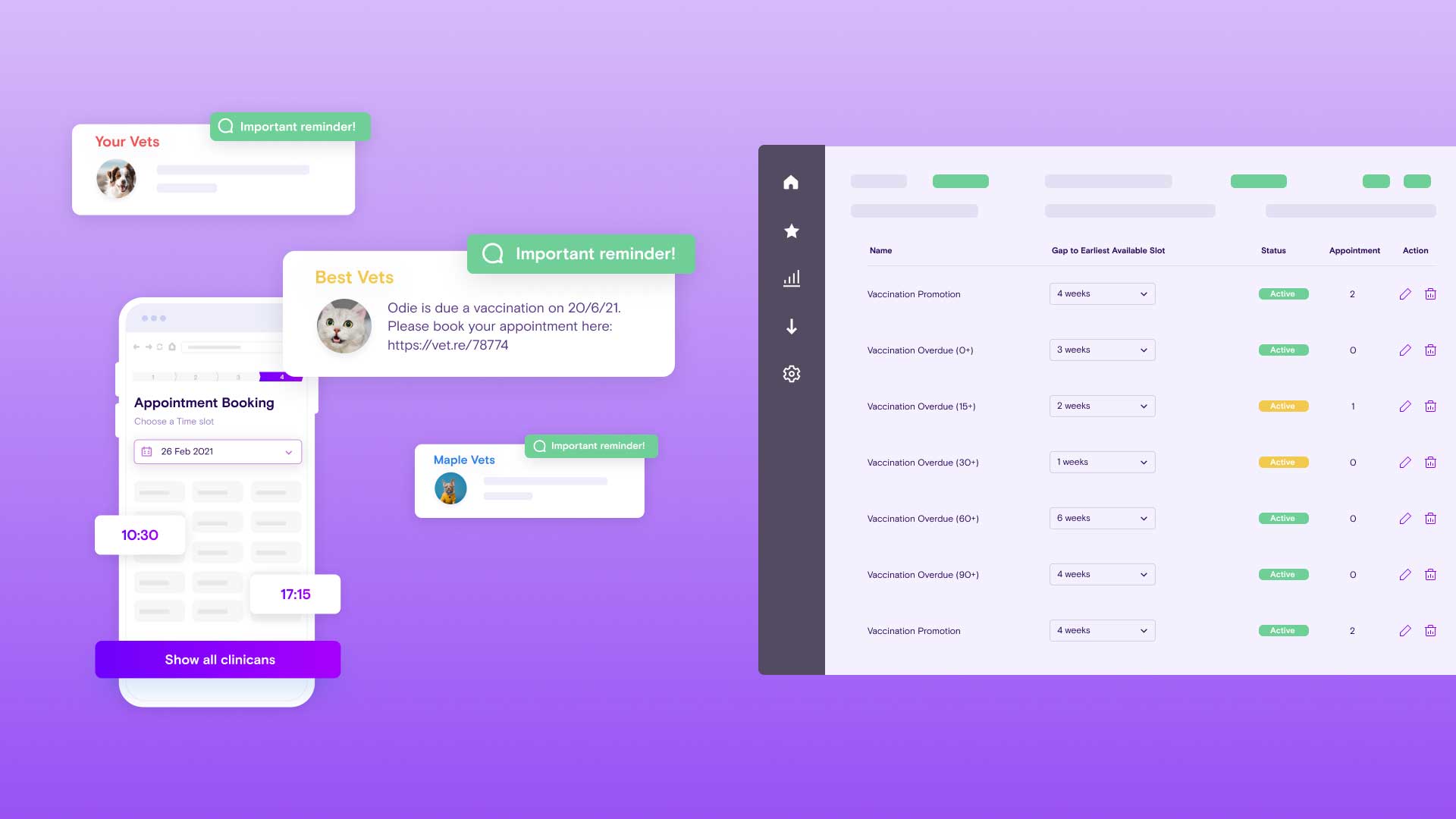
Manage your vaccination backlog more efficiently with Vetstoria + iRecall®
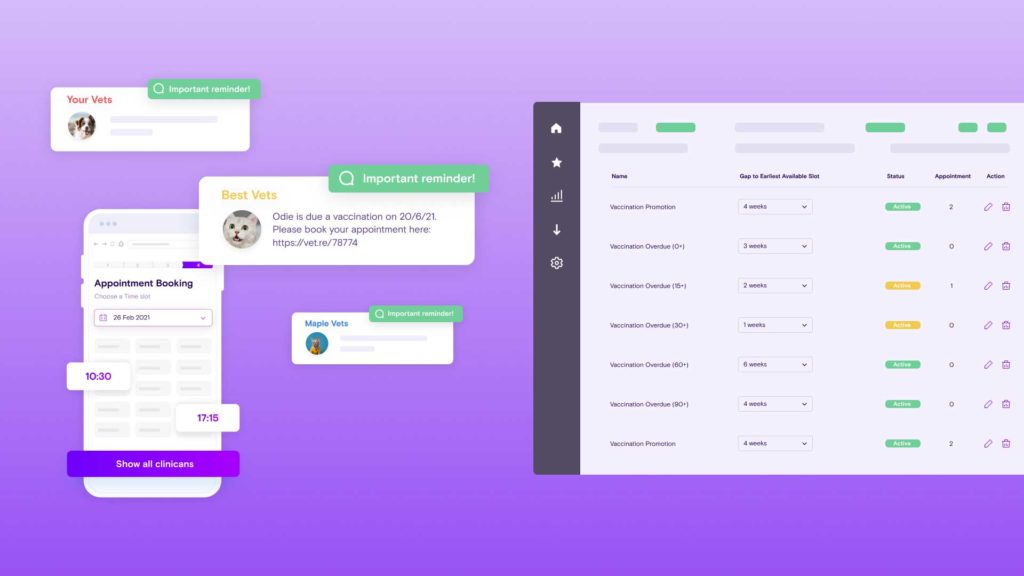
Vaccination reminders with SmartLinks and iRecall®
Veterinary practices that use Vetstoria and iRecall® can now control the availability that pet owners see when booking appointments online based on their pet's vaccination due date within iRecall®.
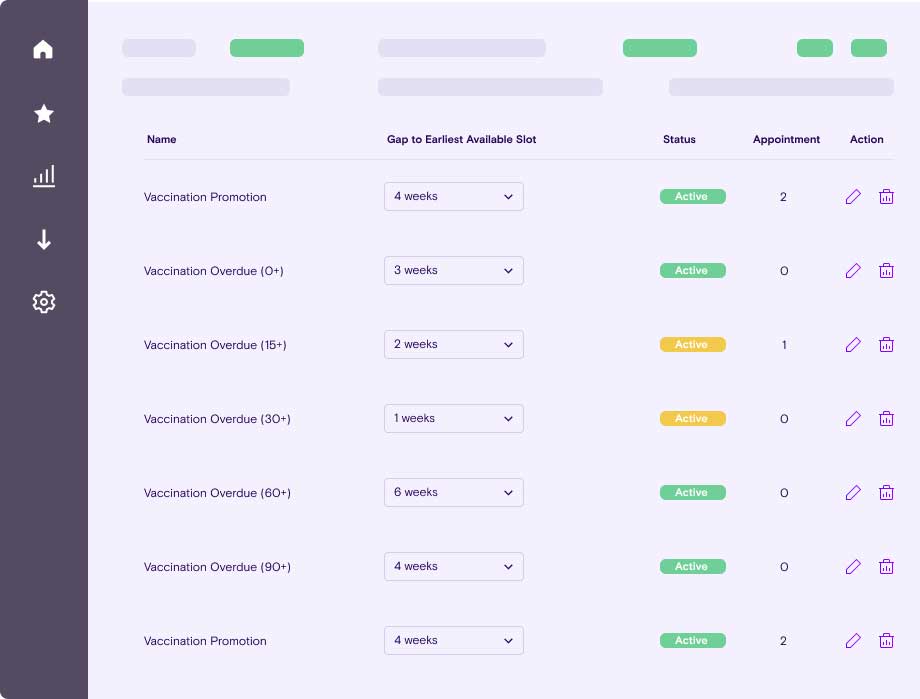
With the new integration, practices can define custom availability rules, based on how overdue a vaccination is, within Vetstoria using the SmartLinks feature. This allows your practice to automatically prioritise the most overdue patients to be seen soonest when the vaccination is most critical.
For example, you can decide that pet owners who are 90+ days overdue for vaccinations would see appointments available this week, whereas owners of pets that are only a week or two overdue will see availability three-weeks from now.
This allows your practice to ensure that the most overdue patients are seen the earliest.
What is a Vetstoria SmartLink and how does it work with iRecall® reminders?
Vetstoria SmartLinks are unique auto-generated links that are embeddable in any digital communication sent to clients (email and SMS reminders for example).
With the new Vetstoria and iRecall® integration, Vetstoria SmartLinks can be embedded within your iRecall® vaccination reminders.
When an email or SMS reminder is sent to a pet owner, and they click on the link in the reminder, it will pass information about them, their pet, and vaccination due date to the Vetstoria online booking widget. The pet owner will then see appointment availability based on the vaccination due date and the availability rules you set.
Want to enable smart vaccination reminders?
If you already use Vetstoria and iRecall® and you want to start managing your vaccination backlog more efficiently, contact support and we'll help you get up and running!
If you're not yet a Vetstoria customer and want to see how this feature, as well as many others, can help your practice operate more efficiently, book a quick demo with one of our friendly product specialists today.
More about iRecall® Vaccination Reminders
iRecall® provides your practice with the tools to remind 100% of your clients, 100% of the time with timely prompts to book online at a time that suits the client. With SMS, email, and post reminders, you can be sure to reach all your clients with important reminders. SMARTdelivery provides you with complete visibility of which clients have received messages and most importantly means you'll have the best odds of reaching every client, every time, fully automatically.
Get in touch with iRecall® to learn more

5 Simple Veterinary Social Media Tips For Your Practice

Are you really harnessing the power of your social media platforms?
Social media has become the most-used channel by Millennials, who are also the largest segment of pet parents, with 76% of them owning pets, accounting for 31% of total ownership. And let's not forget the emerging Gen-Z's, the 18-24-year-olds, who account for 11% of total ownership - they live on social!
Despite this, a number of veterinary teams neglect their social channels, seeing them as a burden, or merely a marketing tool that is only required when in need of new business. However, If used in the correct way, social media can also save you and your team hours of valuable time every week and help you develop stronger relationships with your customers.
To help you get more from social, we've shared 5 easy-to-implement tips that will make your customers (and team) happier.
Free eBook: Digital Marketing for Veterinary Practices
1. Show 'behind the scenes'
Sharing images of your team or patients within the practice environment is a great way to show the personality and caring nature of your team. Pets are precious and any parent would appreciate getting a glimpse of the care their loved one would receive should they visit your practice.
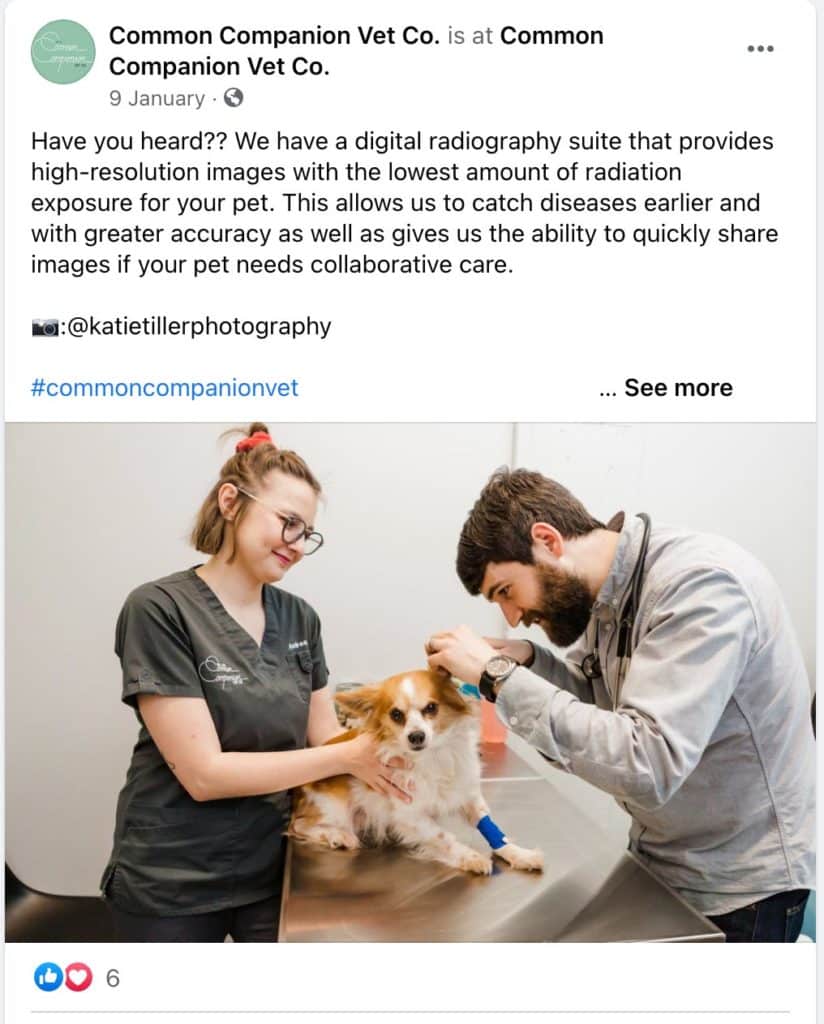
The same goes for existing customers. A familiar face popping up on their social media feed helps them feel part of your practice family, and keeps your practice top of mind when it comes to booking their next preventative treatment.
These posts don't need to be complex - a simple shot of a happy 'tail-waggin' patient after treatment or a selfie of your friendly receptionist goes a long way!
2. Ensure you're easy to find
Since social media is the preferred channel for many pet owners to interact with veterinary practices, helping them find your page and interact with you quickly and easily is essential.
Start with your profile name and keeping it simple. The exact name of your practice is usually the best way to go. Use your logo as the profile photo and add a cover photo that helps pet owners easily identify your brand.
It's important to include as much detail as possible in the about section - you can use this to display opening times and appointment types that you currently offer, as well as your contact details and website URL.
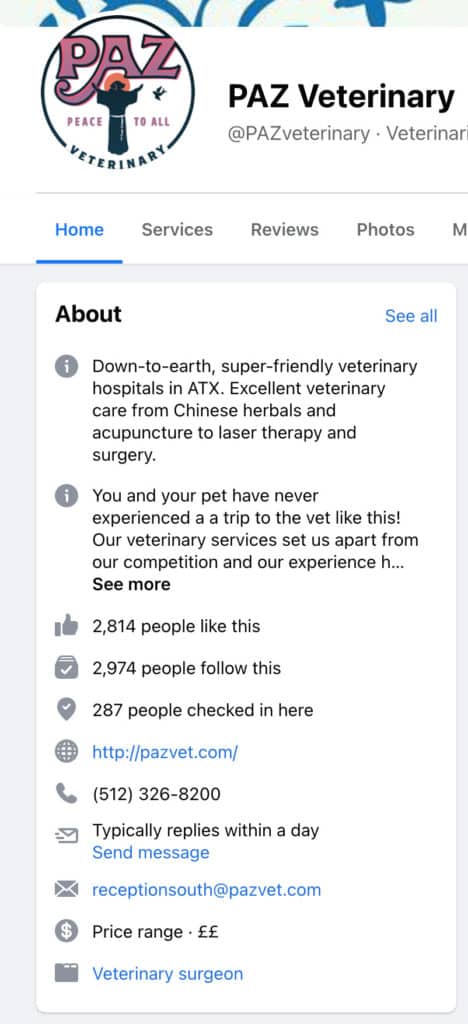
Remember, this is one of the first places pet owners will check if they want to contact you, and if populated with the right information, can reduce the number of phone calls you receive asking "what time do you open" or "which species do you treat", saving precious time for your team.
3. Share user-generated content
User-generated content (UGC) is any content - text, videos, images, reviews, etc. -created by people, rather than brands.
Sharing UGC is a powerful tactic for veterinary practices because consumers are 2.4 times more likely to view user-generated content as authentic compared to content created by a business. This offers practices an important credibility boost that builds trust with potential customers and promotes loyalty with existing ones.
Here are a couple ideas to get you started:
- Scroll through your reviews on platforms like Google or Yelp. Select the best ones and add them to a pre-designed social media image template (using a free tool such as Canva). Post the image of the quote with a caption thanking the customer.
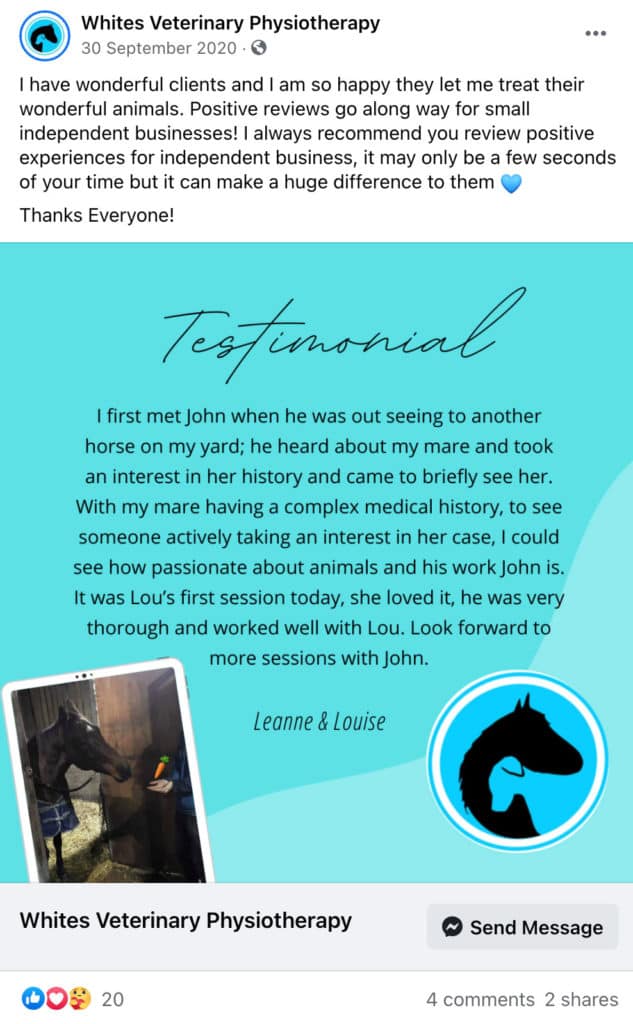
- Encourage customers to use brand-specific hashtags, and use search streams to find user-generated content you might have missed. By using a social listening tool, you can keep an eye out for all mentions of your practice on social media. If you find a post you’d like to share with your audience, get in touch with the content creator and ask permission.
4. Use social media as a communication channel
Most social media platforms have their own direct messaging or live chat feature, which is excellent. Although it may seem like an extra duty for your front desk to manage within an already hectic schedule, monitoring communication via social media may actually save more time for your team.
By being responsive on such platforms, you can quickly reduce phone calls for unnecessary inquiries and questions. In cases where you need more time to respond to messages, some platforms give you the option to add automated responses, which will keep the customer engaged.
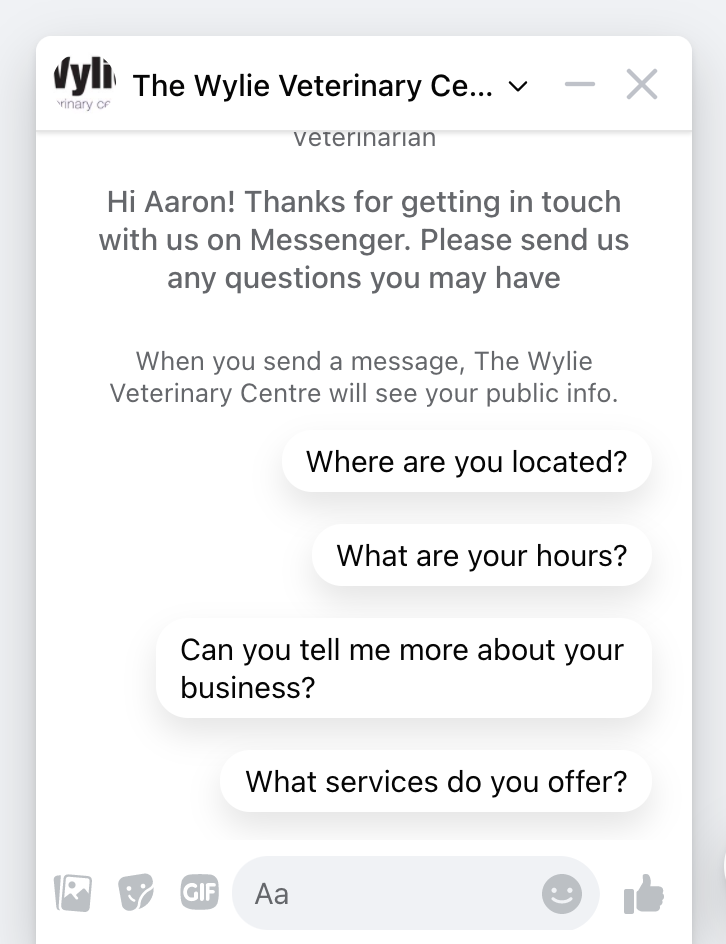
You can further automate the potential questions based on what's asked most and serve automated responses to each, as shown in the screenshot below:
Social media platforms like Facebook and Instagram provide excellent opportunities for veterinary clinics to reach and engage with their target audience. By creating a business page on these platforms, clinics can share informative and engaging content that showcases their expertise and services, while also building relationships with pet owners in the community. These platforms allow clinics to post photos and videos of their facilities, staff, and patients, as well as share pet health tips, news, and promotions. Additionally, paid advertising on Facebook and Instagram can help clinics reach even more potential clients and drive traffic to their website. Overall, incorporating Facebook and Instagram into a veterinary marketing strategy can be an effective way to connect with pet owners, increase brand awareness, and attract new business.
To learn more about how you can you use Facebook and Instagram to promote your veterinary clinic here for Instagram and click here for Facebook.
5. Conduct giveaway campaigns
Pet owners love to share, comment on, and like social media posts, even if they don't involve them. Most of all, they enjoy receiving free giveaways for themselves or their fur babies.
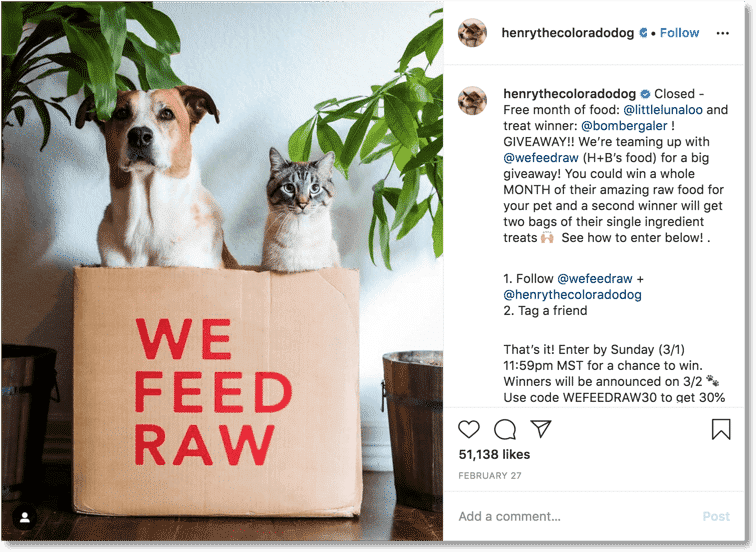
Giveaway campaigns usually work very well on social media. You will be asking pet owners to follow some steps to be in with winning themselves a prize. This can also be done by partnering with another vendor such as a pet toy or food supplier, making it more exciting and increasing the reach of the campaign.
By doing this, you can grow your followership and generate brand awareness, as well as promoting more advocacy among your existing customer base. Below is an excellent example of such a campaign carried out on Instagram:
Check out 5 Easy Ways To Start Promoting Your Practice.
Final thoughts
There are plenty of creative ways to use social media to save precious time for your team and making customers happier, whilst also driving practice growth.
If you haven't already, give some of the above methods a try! Your team and pet owners will appreciate it 😊

5 Veterinary Time-Saving Tips That Will Boost Productivity

There are only so many hours in a workday and always plenty to get done. How you utilize those hours will go a long way in determining the happiness of employees in your practice, productivity, and overall well-being. Instead of hoping you had more hours in the day, search for ways to save time without cutting corners.
Initiating some of the below veterinary time-saving tips help increase the productivity of you and your team members. They can also help reduce stress in the workplace. The less stressed we all feel, the better care we can provide our patients.
Free Download: 5 Veterinary Time-Saving Checklists
1. Dedicate specific times for tasks
Schedule in time during the day for you or your team to tie up those loose ends that can quickly unravel. This means paperwork, callbacks, ordering products, and other administrative duties. Try to avoid cramming tasks into lunch breaks or other scheduled breaks; try to ensure they take place at their dedicated times.
Not only will this allow you the time to complete tasks with no need to burn the midnight oil, but it can also make clients and team members happier. Clients will appreciate a quicker return time for callbacks and fewer mistakes on billing than when you’ve done a rush job of charting. And your team will appreciate a more reliable flow in their daily activities.
2. Spread the workload
Veterinary employees of different roles have a lot to take up: treating patients and providing customer service, payroll, equipment maintenance, managing inventory, and ensuring the smooth running of the practice, to name a few.
It isn't realistic for each employee to execute everything without overwhelming them. That's where delegation comes in. Splitting the work across individuals and roles leads to efficiency improvements.
Assigning specific tasks to each team member will lead to more accountability and increase work satisfaction. It also leads to time-saving, as it provides an opportunity to delegates certain tasks to those who are best or most efficient at performing them.
The practice manager may do a better job at managing payroll, while your lead technician may be in charge of equipment maintenance and issues. An associate vet can handle the inventory needs, while a receptionist may be best to deal with difficult customers. Find the strengths of your team and embrace them.
3. Upskill your team
Investing time in training for your team members may be the most worthwhile time saver that there is. While training may initially cost more time and potentially money, employees that are well trained and know their jobs will work more efficiently.
Not only will this allow your practice more opportunity to help more patients in less time, but it will also improve the level of service offered drastically. Highly trained team members are also more likely to feel satisfied with their job, being more invested and less likely to look elsewhere.
4. Focus on communication
Nothing can slow down progress more than having to repeat instructions or plans to each person individually. Having team meetings, message boards, or communication apps in which you can outline plans with your team members quickly and efficiently will be a big time saver.
Communication with clients is also a critical veterinary time saver. The more knowledge and understanding of procedures, illnesses, and preventatives that you can instill in your clients, the fewer phone calls, unnecessary rechecks, and emergency appointments you’ll have to undertake.
Make sure your entire team communicates the same message with the clients. You can do this by writing up instructions for surgery discharge, medications, vaccinations, and have your team follow these guides so that clients get the same instructions every time.
5. Stay organized with tools
Organization plays a huge role when it comes to saving time. However, being organized doesn't come naturally to all of us. This is where the smart usage of tools comes in.
One of these tools that can help you get more organized and save time are checklists. You can use them to manage recurring tasks. Imagine a morning opening checklist for receptionists, including tasks such as turning on computers, sending out appointment reminders, and flagging urgent emails. Following this will ensure everything's covered.
Similarly, a checklist for running lab tests, shipping specimens, preparing for surgeries, and closing out the day could be used by veterinary surgeons or technicians.
Just as creating your own checklists help you stay organized, repurposing pre-made templates from a similar clinic will help you save time that you may otherwise have to spend on creating your own. There are plenty of easily accessible templates on the internet that you can either use straight away or customize to meet your needs. In fact, we've created 5 Veterinary Time-Saving Checklists that you can download and use for free.
Another category of tools that facilitates organization is software. Implementing software that automates repetitive tasks such as online booking, taking payments, or sending reminders is a sure-fire way to staying organized and on top of everything.
Check out 5 veterinary software tools that will boost your team’s productivity.
Final thoughts
Make more time for yourself and your team by implementing the five veterinary time-saving tips mentioned above. You'll notice productivity improvements and increased happiness across the practice.
If you want to measure the levels of happiness among your team, feel free to download our veterinary employee happiness survey template - it's an easy way to measure employee happiness!
Take the proactive step towards a more streamlined practice and enhanced well-being. Book a demo today to explore these tips further and witness the positive impact on your veterinary team's productivity and happiness.

How Veterinary Checklists Can Save You Hours Every Week

Whether it comes as second nature to you or is something you need to work on, being organized within your veterinary practice has many benefits. One of the most comfortable and effective changes you can make to your routine is using veterinary checklists.
The small amount of time and effort it takes to put these checklists in place on your own or even browsing the internet for freely available checklists will help you become more efficient and have you reaping the rewards for years to come.
Research with 7,688 human patients in eight hospitals worldwide shows a drop in death rates to 0.8% after using checklists from 1.5%. Furthermore, serious complication rates in New Delhi, Tanzania, Ifakara, and Seattle dropped from 11% to 7%.
A checklist may seem like a somewhat dull tool to have in your practice management toolbox, but it is far from it! The humble checklist not only prevents you from making errors; it can save you precious time every single day. Your co-workers will be amazed at what a well-oiled machine your practice becomes once you are routinely using checklists.
Free Download: 5 Veterinary Time-Saving Checklists
Veterinary checklists for multiple purposes
Checklists can be used in various areas; they are wonderfully versatile. Some of the more common checklists used in veterinary clinics include:
- Veterinary Triage Checklists (to attend to emergency patients)
- Inpatient Checklists
- The ‘Weekly’ Veterinary Housekeeping Checklist (this may include bathroom cleaning, shelf stocking, and checking sell-by dates)
- COVID-19 safety checklist (relevant especially in the current climate)
When we have a comprehensive checklist in front of us, we can complete each task in record time.
Offers the perfect fail-safe method
Having a checklist that includes all of your critical weekly tasks is paramount. It prevents disasters from occurring and keeps staff and pet owners happy. For example, you may put ‘pay staff wages’ on your list. While this may be an obvious thing you would rarely forget to do, a checklist means you have a dependable safety net. You certainly don’t want to wake up in a sweat on Friday night, realizing you have forgotten.
Drives practice staff productivity
Using your veterinary checklists will soon become a streamlined activity and will naturally mean you have more time. By having an efficient system in place, your productivity is sure to increase. Your ‘brain space’ will be freed up to work on more crucial tasks and spend more time with your staff. The benefits will be felt across the practice as a whole, resulting in improved client satisfaction and practice growth.
Helps ensure safer pet care
Working in the veterinary industry, you know how important safety is when it comes to pet patients. Owners sometimes ask about your safety record when it comes to anesthesia and surgery. By ensuring veterinarians use a ‘Surgical Safety’ Veterinary Checklist for every procedure that involves anesthetic, we prevent errors from occurring. Amazingly, a Swedish study in the International Journal of Surgery demonstrated a 10% reduction in post-op complications when a checklist was implemented.
When we prevent errors before they have occurred, we don’t have to spend time cleaning up the mess’. Those client conversations about mistakes and complications can be the most challenging and draining and are best avoided where possible.
Spreads out responsibilities
Insisting that one person is responsible for each checklist is a good idea. To lessen the burden, consider giving each team member a different checklist. For example, surgical checklists being owned by nurses or technicians, housekeeping checklists being owned by practice managers, and new patient onboarding checklists being owned by receptionists.
The above will help prevent errors from occurring and bring to light those team members who may need more training in certain areas. Checklists can be rotated between individuals if preferred.
Increases pet owner confidence
Not only will your staff be happy working in an organized clinic, but using checklists will also gain pet owners’ trust. Did you know that 93% of people surveyed in one study said they would prefer if their surgeon used a surgical checklist?
This statistic should not be ignored! The impression that it gives is of a slick and modern practice that is keen to maintain high standards. Checklists take mere minutes to fill in, but the benefits are long-lasting.
Makes delegation easier
We all appreciate that delegating in a veterinary practice can get awkward and uncomfortable at times. Individual employees dislike being directly told what to do. We may put off delegating in the hope that the task gets done in its own time.
However, working like this creates unnecessary anxiety and reduces productivity and efficiency. Instead, we can use a checklist that delegates specific tasks to individual staff members. This fair and straightforward approach avoids confrontation and prevents time-wasting. No longer will you have to spend your valuable minutes seeking staff out and directly telling them what they have to do; they will already know!
Motivates team members
Veterinary checklists can be used for a multitude of purposes. They can be put up around the practice, be pinned to your computer (or tablet) home screen, or kept on a bulletin board. Ticking off each ‘completed’ task helps keep staff motivated. There’s also something profoundly satisfying about filling in that last tick!
Implementing checklists in your practice
The benefits of veterinary checklists are vast, and they inevitably result in a more efficient and well-organized practice - resulting in hours saved every week. If you haven’t started to use them yet, ask yourself why?
Our checklist pack includes:
- Veterinary Triage Checklist
- Veterinary Inpatient Checklist
- Veterinary Hospital Housekeeping Checklist
- Veterinary Receptionist Checklist
- Weekly Reusable Spreadsheet with all 5 checklists
You can easily create a spreadsheet to manage this, search Veterinary Checklists in Google for inspiration, or download one of our free 5 Time-Saving Veterinary Checklists here. Trust us, you won't look back!

5 Veterinary Software Tools to Boost Your Team's Productivity

In the words of the great Albert Einstein, 'It has become appallingly obvious that our technology has exceeded our humanity.' The fact is, if we fail to embrace technology within our clinics, we risk falling behind the curve.
The hesitation we tend to feel is understandable. Changing from the paper-based systems we are accustomed to and have used for many years is a daunting prospect. There is a concern that we may incur extra work and take time to install the systems and train staff. The fact is, in the long-run, using veterinary software tools offers many benefits, and the time spent implementing them will only end up becoming an investment.
Free Download: 5 Veterinary Time-Saving Checklists
Internal communication tools
Internal communication tools are one of the latest software trends to be adopted within the veterinary world. Social distancing measures and increased work-from-home policies brought to light by the COVID-19 pandemic have contributed to the rise.
These innovative programs ensure that practice staff can openly communicate with each other at all times, wherever they are. For any questions they have, they can get a near-instant response. These tools can also help managers send out company-wide memos, schedules, and information bulletins, bringing everyone closer and keeping them united.
The most popular work chat tool is Slack, which is free to use. For video calls, Google Meet or Zoom are great options. All offer the ability to talk one-to-one in private as well as in groups, which is perfect for practices of all shapes and sizes.
Website chat tools
Live webchats and pre-programmed chatbots are on the cutting edge of the technology available to veterinary practices. Chatbots are intelligent software bots that work for you 24/7, acting as a support network for your clients when you're not available. Although chatbots can be programmed to manage the triage process or provide clients with useful information, they have their limits.
Live webchats can complement chatbots and help clients with more complex queries and concerns. In these cases, having a live webchat with automated chatbot functionality is the ideal solution. We've seen an increasing number of veterinary professionals use these tools on their site to add an additional communication channel to engage with pet owners.
The automated bot functionality in particular can free up busy reception teams who may otherwise have to answer queries over the phone.
Popular chat tools that feature a live chat with bot functionality include Intercom, LiveChat, and Podium.
Online booking platforms
We've all suffered through those long conversations over the phone with at least one client who owns eight cats. What should take one minute like a phone call to book in the pet's annual booster ends up taking twenty as they entertain you with all of the latest anecdotes. As pleasant as it can be to catch up with clients, they don't always realize that we have a load of work to do!
By allowing your clients to book appointments online, you can free up those phone lines. Clients also appreciate this service, which prevents them from having to wait on hold for too long. Approximately only one in four clinics currently offer this service, despite the convenience it offers clients - however, this is fast changing as modern pet owners demand the ability to book online. Offering online booking could even be the difference between a new client coming to you or a rival practice.
Some practice management systems offer online booking as an add on. However, since their focus area isn't online booking, the features are often suboptimal.
There are also 'Request an Appointment' systems, which offer an affordable introduction to managing the booking process online. However, since they don't sync with your practice management software calendar in real-time, they often create more work for admin teams, as they require manual confirmation of appointments and a lot of back and forth.
The best option (and we say this without bias 😉) is Real-Time Online Booking, such as that provided by Vetstoria's platform. Not only is the software built by vets with the daily challenges presented in the practice in mind, but it is totally customizable to match your existing booking process. Have a veterinarian who only wants to offer routine vaccinations to cats between 9 am, and 11 am every Thursday - you got it!
Furthermore, since Vetstoria connects with your practice management software in real-time, everything is automated. Once Vetstoria is set up on your site, it will only show available appointments based on your existing practice schedule. This means pet owners can choose an appointment online and have it confirmed within seconds with no work from the admin required - time-savings galore! 😀
Digital design tools
Not all of us are artistic and imaginative, and it can be tricky to create a flyer or leaflet for pet owners that stands out from the crowd.
Instead, why not leave it up to technology? You can save your team the hours it would typically take to think up designs and color schemes by letting design tools take over. The finished product will be sleek and professional, impressing your existing clients and likely attracting new ones.
Canva is a well-known free tool that is easy to use without any training. Their simple interface can be accessed via the web to use a template for any category of designs you need, allowing for easy editing on the go.
Online payment software
Giving your clients the option of paying online is mutually beneficial for both you and them. It significantly speeds up the payment process and leaves little space for error. It also means less time counting cash and reconciling accounts; how many times has the phone rung while you're in the middle of the coin count or taking a card payment? Clients also tend to prefer this option, viewing it as safe and convenient. With the arrival of the COVID-19 pandemic, the move away from in-person payments is also recognized as a safer way to operate.
When it comes to taking online payments, there are a few options. First is to use a payment gateway such as Paypal, Stripe, or Worldpay to take payments on a 1-to-1 basis. This can be achieved by sending a unique payment link to each pet owner (either by email or SMS). However, the drawback is that this still requires some admin time and effort to link each payment with a pet owner or appointment.
The better option would be an integrated payment solution that is part of the booking process. Vetstoria, for example, offers the ability for practices to require payments from pet owners during the online booking journey. This offers all the convenience of online payments without any of the admin work!
Final Thoughts
By using veterinary software tools to your advantage, your team will save time and boost productivity, and establish itself as the leader of the pack. There are countless available products out there that you can use to meet all of your practice needs. When these tools are used appropriately, your practice will be elevated and running like a well-oiled machine in no time!

Veterinary Workplace Culture Survey: A Summary of Our Findings

Culture is a vital part of the veterinary practice environment, as it plays a significant role in recruitment drives, practice growth, employee morale, and pet-owner experience. Additionally, it gets many out of bed every morning, motivating them to work. However, for veterinary employees responsible for driving that culture, it can be one of the most challenging parts of the job.
We recently carried out a veterinary workplace culture survey to understand practice employees' opinions on their workplace culture. Over 250 respondents working across different roles in the practice took part, including receptionists, practice managers, nurses, veterinary technicians, and surgeons.
Some of our key findings:
- 62.5 % have experienced bullying within their practice
- 37.5% feel that 'stressed colleagues' impact practice workplace culture most
- 14.1% are concerned that their practice workplace culture isn't positive
- Over 80% of respondents have experienced abuse from pet owners
- 62.3% agree that technology can positively influence practice culture
Free Webinar: Is Positive Workplace Culture Still Possible In Veterinary Practices?
For better or worse? COVID-19's impact on practice workplace culture
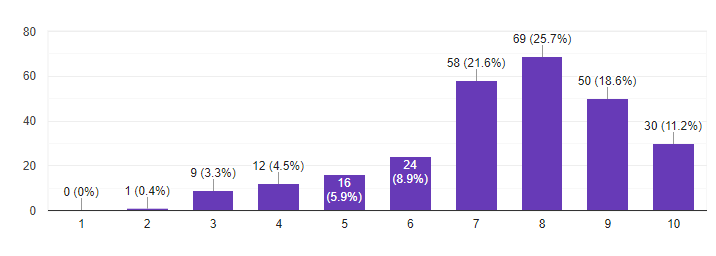
Question 1: On a scale of 1 to 10, how is the workplace culture within your veterinary practice?
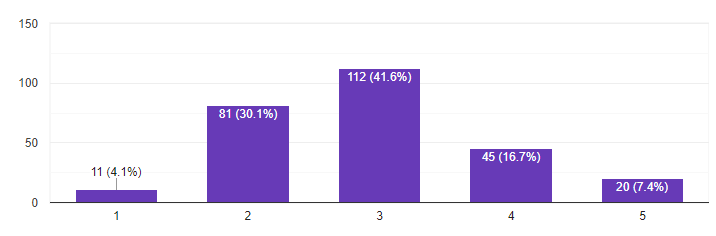
Question 2: What impact has COVID-19 had on the workplace culture within your practice?
Analysis:
Veterinary practice workplace culture has been an essential part of how several practices have survived the complications of COVID-19. However, the pandemic is also changing these same practices’ cultures, positively as well as negatively.
We see a close connection between our respondents’ views on what their practice culture currently looks like and the impact the COVID-19 pandemic has had on it.
To our surprise, a whopping 86% of survey respondents were convinced that their practice workplace culture is positive (answered between 6 and 10 to figure 1). This is higher than we expected, however, we must point out that a large portion of our respondents are Vetstoria users (shameless plug - but it could be a contributing factor).
One thing we can be sure of is that COVID-19 has forced practices to see, think, feel, plan, and act differently.
14.1% list their practice workplace culture on the negative side of the scale (answering between 1 and 5 to figure 1). Furthermore, 34.2% agree that the COVID-19 pandemic has impacted their practice culture negatively (answering 1 or 2 to figure 2).
In contrast, 24.1% of respondents stated that they think their practice culture has improved due to the pandemic (answering 4 or 5 to figure 2). This could be a sign of coming together and unity that is a great thing to see in our industry! 😊
The biggest contributors to veterinary workplace culture
Question 3: Which of the following factors do you think currently impacts workplace culture most?

Analysis:
The elements that largely impact practice workplace culture positively are practice leadership, practice management, policies, and people. However, many practices fail to pay attention to these factors, and improving practice culture is often the least of their concern, especially in the midst of a global health pandemic.
Our survey showed that respondents thought that having stressed colleagues at the practice impacts practice workplace culture the most( 37.5%).
The second most chosen factor was changes to pet-owner behavior, with 25.7% of respondents conveying that changes to attitudes and expectations are significantly impacting their practice workplace culture.
15.4% selected new COVID-19 safety measures as the biggest factor. And quite surprising was the fact that only 8.6% of our respondents thought that reduced staff numbers have impacted their culture most. Considering the impact that COVID-19 has had on the global workforce, we expected this number to be slightly higher.
Not all practice employees feel valued
Question 4: Do you feel that you are valued within the practice?

Analysis:
When veterinary employees feel valued, their sense of self-worth increases. This enhanced sense of worth and respect are critical drivers in building loyalty, morale, and happiness, creating a positive workplace culture.
In our survey, 68.7% of our respondents stated that they do not feel valued within their practice. An additional 4.8% stated that they don't feel valued as much as they'd like.
With almost three-quarters of respondents stating that they don't feel as valued as they like or at all, it's no surprise that practice workplace culture is a big discussion topic right now.
If you're struggling to think of ways to make employees feel valued within your practice, here are some easy ways to help: show recognition, give feedback, communicate, and reward employees for their hard work.
The majority of practice employees have experienced bullying
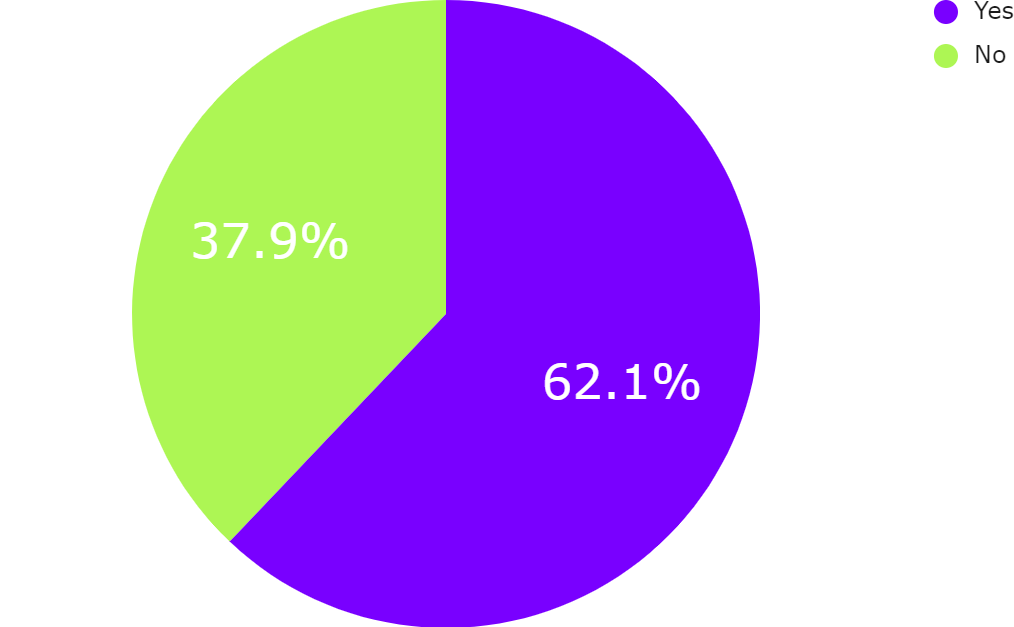
Question 5: Have you personally experienced or witnessed bullying within a veterinary practice?
Analysis:
Sadly, bullying is rife within veterinary practices. This is reflected by the fact that 62.1% of our 250+ survey respondents have stated that they've witnessed or experienced bullying in the profession.
Such high levels of bullying have the potential to create problems that extend beyond workplace cultures, such as high absence rates, employee turnover, low morale, and stress.
Most practice employees experience pet owner abuse, some are not supported
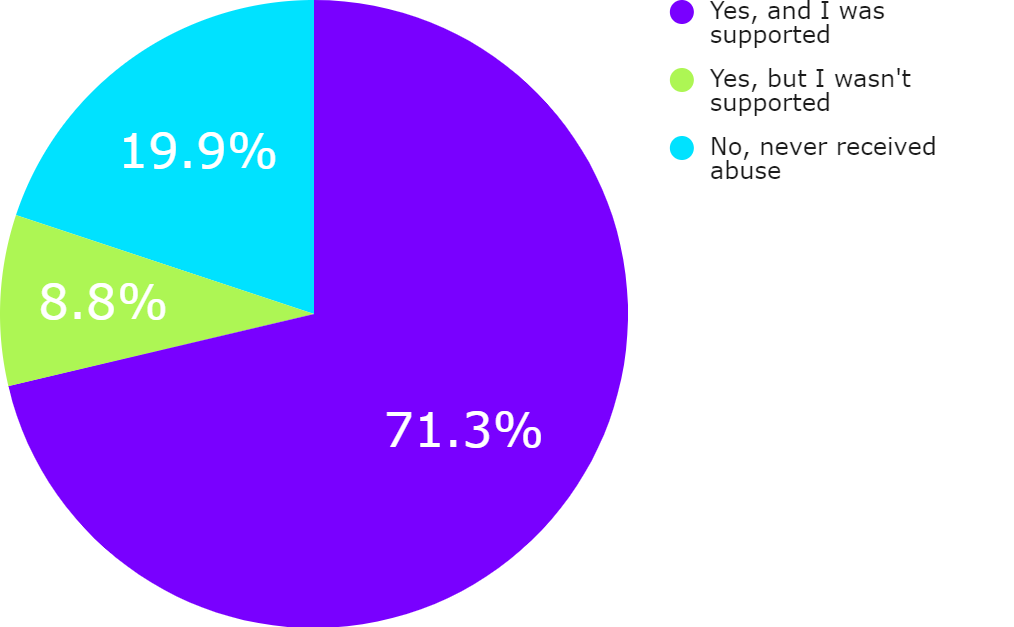
Question 6: Have you experienced abuse from pet-owners and did you receive support from your team?
Analysis:
Yes, most frontline workers face physical and verbal abuse at some point. However, any veterinary professional will tell you that this is commonplace within the practice. High emotions play a role here, but considering the effort and sacrifice veterinary professionals put in to provide animal care; it's sad to see it happening.
Sadly, over 80% of our respondents have experienced abuse from pet owners. The consolation is that 71.3% stated that although they have faced such abuse, they were backed up and supported by other practice members. However, that still left 8.8% that received abuse from pet owners but unfortunately weren't supported.
If we are to drive our industry forward, practice teams need to pull together and support each other. This will further enhance the culture and make the professional more rewarding for all involved.
The role practice managers can play in improving culture
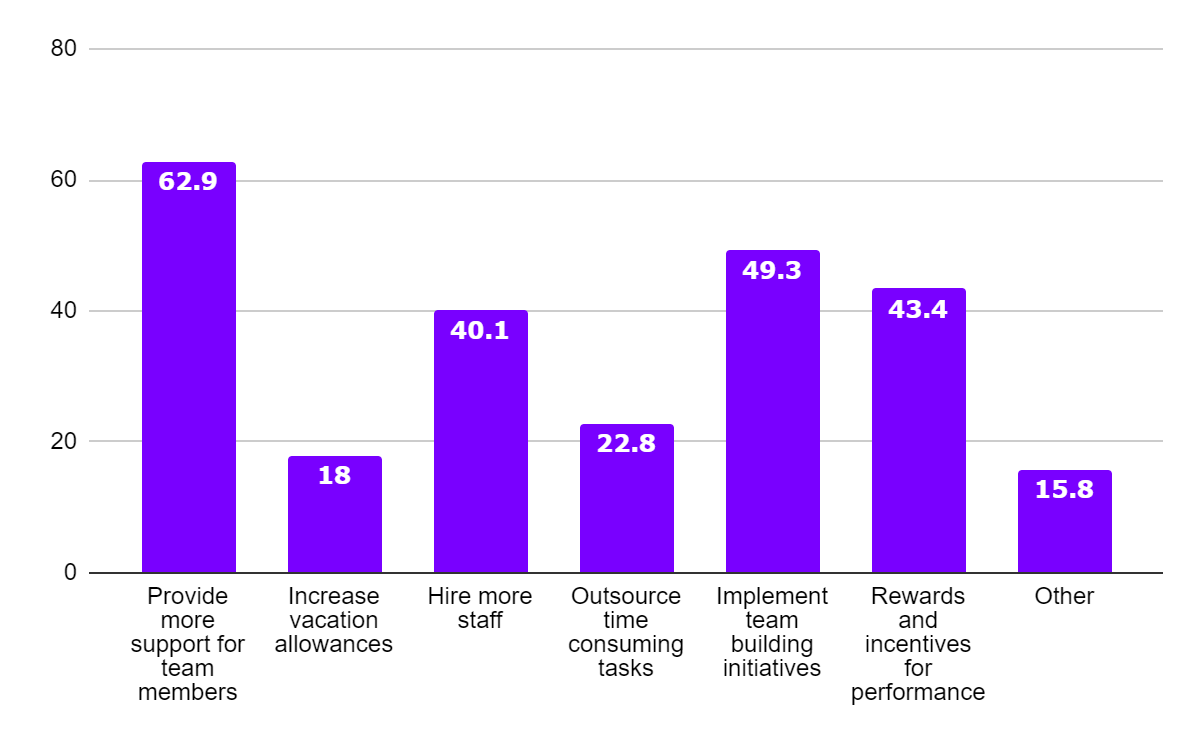
Question 7: What can practice management do to facilitate positive workplace culture?
Analysis:
The practice management team (or practice manager) has the most influential role when it comes to shaping the culture within a veterinary practice. After all, they are usually responsible for the day-to-day running of the practice.
When asking our respondents what practice management could do to facilitate positive workplace culture, the most popular choice by far was 'Provide more support to team members' (62.9%). Other popular choices included: 'Implement team building activities' (49.3%), 'Hire more staff' (40.1%), and 'Rewards and incentives for performance' (43.4%).
While some of the above may be difficult to implement, as they require financial investment, the the return on investment seen in increased productivity, higher staff retention rates and improved pet owner experience lead to a most prosperous business in the long-run, and therefore should be considered.
Another interesting selection was 'Outsource time-consuming tasks', with (22.8%) of respondents agreeing that time-consuming admin tasks that can easily be automated are still being fulfilled by themselves.
Furthermore, having to perform repetitive tasks impacts the practice culture due to the increased stress felt by those responsible. Therefore the suggestion of outsourcing such tasks is justified. This outsourcing can take the form of hiring an external team to do the work or using technology to handle it.
This leads to the final question we asked our respondents, can technology influence workplace culture?
The role technology can play in improving culture
Question 8: Can technology influence workplace culture?

Analysis:
66.9% of our respondents thought technology could influence their practice workplace culture, out of which 63.2% thought it was for the best, and 3.7% thought it was for the worse.
Technology influences the culture of veterinary workplaces. However, the technology you use in your practice will not create or change a culture single-handedly. It needs to be implemented to enhance your existing culture and processes.
What types of technology can influence the culture in your practice?
Internal communication tools:
Communication software helps build connections between all practice employees and facilitates practice managers and other staff collaboration. Such software further ensures every person is involved and is always on the same page, reducing frustration and unnecessary work repetition. Examples of these technologies include Slack, Zoom, or Google Meet.
Practice management software:
Practice management software helps manage and track patient information, financial data, appointment schedules, and more. A good system is a difference between chaos and harmony, and a well set-up and utilized system can definitely reduce stress within the practice.
Online appointment booking platforms:
Online appointment booking platforms such as Vetstoria automate one of the most time-intensive tasks that veterinary admin teams face - booking appointments. If the platform integrates with your practice management software's schedule, it will save a huge amount of time whilst improving the pet owner experience (no more waiting on hold). Happier staff and happier pet owners - what better way to improve the practice environment?

Veterinary Stress at Work: 8 Simple Ways to Deal With It

Biting dogs, upset clients, ringing telephones, and long hours are all part of a day in the life of a veterinary professional. Since veterinary stress at work isn't going to go away, it's up to you as a leader or colleague to help your team manage it in the best way possible to ensure everyone's happiness and productivity.
Recognizing stress in yourself and your coworkers is the first step in reducing it and saving your team, as nearly 42% of us have seriously thought about quitting our jobs. If your team is continuously bickering, making mistakes, or expressing their unhappiness, stress at work could be blamed.
Free Download: Veterinary Employee Happiness Survey Template
Many jobs are stressful, so what's the big deal with veterinary stress? The big deal is that stress can negatively affect our mental and physical health as well as productivity.
Mental health is already a concern in veterinary medicine, as nearly 25% of veterinary professionals have thought about suicide. Additionally, nearly 80% have experienced extreme depression. We all can agree that those numbers are too high.
Stress reduction in the workplace can go a long way in bettering your team members' mental health and increasing productivity for the bottom line of your veterinary practice. So how do you go about decreasing that stress? Let's find out.
1. Talk about It
It's no secret that stress is a problem in veterinary medicine. Rather than hope that it goes away, bring it into the light. Hold regular wellness meetings or provide your team with questionnaires to reveal where they feel stressed and ways that may help them cope.
As a team leader, you may need to start by sharing your stressful experiences first so that your team can muster the courage to open up.
2. Identify the causes of stress at work
Knowing what causes stress within your veterinary practice and recognizing when you or teammates are feeling stressed will help you take a step back and do something about it before it's allowed to escalate. This may coincide with talking about it.
Maybe you or other team members didn't realize that something was stressful until another person brought it up. Open and honest communication will help everyone become more in touch with how their job makes them feel.
3. Set clear expectations
Nothing's more stressful than not knowing what your job is or how to do it, especially when you are new to a practice or unfamiliar with a system that's been brought in. There may be some stressful trepidations among team members that don't fully understand their roles.
Ensure that everyone has a precise understanding of what is expected of them by providing them with a printed outline of their duties and giving them the training they need to be successful. If you are unclear yourself, discuss with your superiors to reach an agreement and gain relevant training.
4. Break tasks up
Give everyone a much-needed breather (or breathers!) throughout the day to give them to get a second to relax, unwind, and recharge. It never hurts to pencil in some downtime amongst a busy appointment schedule. Having a quiet, comfortable breakroom will help with this as well.
Allocate a deadline or a set time for tasks so you and colleagues don't need to rush to finish everything at once. Attending one task at a time helps heaps in reducing veterinary stress at work!
5. Eat healthy to be healthy
Being hungry is a real thing! Keeping healthy snacks on hands, such as nuts, fruits, and whole grains, will not only prevent those low blood sugar squabbles; it will also help instill healthy eating habits in your team. Physical and mental wellbeing are closely connected, so helping one can help balance the other. Eating unhealthy or fatty snacks instead will only make you feel more lethargic and sleepy, decreasing efficiency.
6. Check on teammate's stress at work
Ask your veterinary team how they are doing. This includes you! While some team members may be hesitant to openly share their work-related woes, a closed-door session may make them more comfortable. Making it a regular part of their schedule will help them feel secure as well.
7. Help with getting help
If you or someone on your practice team is struggling, help them get the help they need. This may include changes to a work schedule or seeing a mental health professional. Whatever will help reduce those stresses, or help someone adapt to them, help them get it.
8. Promote a work/life balance
We can't work 24/7, so having something outside of work that makes us happy is of great importance as it minimizes stress at work. Encourage your team members to pursue outside interests, such as volunteering, family activities, exercise, or education. Providing your team with workshops or information on this may help them figure it out.
Final Thoughts
Stress at work is a real concern in the veterinary industry. If we want to continue to attract and retain reliable, efficient, and effective team members this needs to be addressed, reduced, and dealt with appropriately.
By implementing the above tips and making them part of your practice culture, you'll be on the right track to achieving a positive working environment that is totally stress-free (well, as stress-free as a veterinary one can be 😉).

7 Signs You Have An Unhappy Veterinary Employee (And What To Do)

A veterinary practice that's running smoothly with happy employees all the time is the dream. However, it is not a reality for all practices!
Unfortunately, the likelihood that you have at least one unhappy veterinary employee, who may negatively impact team morale and practice productivity, is not that low. According to research by Robert Half UK, more than 13% of UK employees are unhappy at work, which is more than 4.3 million people in the UK. They further stated that only 42% of employees are happy with their company's rewards and recognition.
Although in most cases, identifying an unhappy veterinary employee is relatively straightforward, there is always the chance of missing the obvious signs.
With that said, in this blog, we give you seven signs that help you identify a disgruntled employee in your practice and explain what you can do to make them happier.
Free Download: Veterinary Employee Happiness Survey Template
Table of contents:
- They engage less with co-workers
- Their productivity decreases
- They start showing up late and leaving early
- They don't participate in team activities outside of the office
- They don't offer feedback or suggest new ideas
- They start receiving complaints from customers
- They're frequently absent or continuously ask for time off
1. They engage less with co-workers
A report on Employee Engagement by TINYpulse indicates that co-workers stimulate the most amount of happiness among employees. When practice team members collaborate well and entrust each other with details around their personal lives, it promotes a positive environment that leads to happiness. Furthermore, good working relationships are a sign of workplace happiness.
If employees don’t seem to get on with one another or you notice a sudden change in the social interactions between one or a few employees of your practice, it may suggest a problem is present. This can often be due to a displeased team member.
If you notice that team members are not getting along, try to invest time in team building. Arrange work drinks night or fun teamwork activities for all practice employees to enjoy - this can help build relationships and ease tensions. If issues still occur, try to speak to each team member individually to get to the problem's root. Like most things, communication is critical here.
2. Their productivity decreases
Suppose an employee in your practice demonstrates a decline in their quality of work and productivity. There's a possibility they are disillusioned or disappointed within their role.
Some practice employees may disengage and 'check out' of their roles entirely. These employees often miss deadlines, or their completed work will appear sloppy or entirely below par. This would be particularly noticeable if the employee in question was once remarkable and extremely productive.
Learn why practice staff are more productive and likely to remain loyal when happy
It would help if you established a dialogue with the employee in question to ensure everything is okay, both at work and home. If they are experiencing trouble with family life, this might affect work. Equally, if they suffer from burnout from being overworked or lose motivation for the role, it's worth carrying out an appraisal to understand what you can do to help going forward.
3. They start showing up late and leaving early
Employees that love their practice environment and enjoy being around their fellow colleagues generally look forward to heading into the practice every morning, they’re usually also the last ones to leave the office.
On the other hand, if you notice a practice employee who frequently turns up to the office late and can’t wait to get out of the doors at the end of the day, it could be an indication of unhappiness in the workplace.

You can avoid such situations and improve employees’ motivation to get to work by organizing fun day-starter events like yoga or morning coffee and snacks. You can even arrange a morning chat or a daily fun meeting with your teammates to make the start of the day more desirable. The key here is building a sense of ‘togetherness’ and building relationships that extend beyond veterinary discussions.
4. They don't participate in team activities outside of the practice
When practice employees are confident and happy in their work environment, they usually spend additional time trying to get to know their colleagues. They initiate conversations and take time to get involved in team activities outside of work. We know this isn’t always the case, as some practices don’t actively encourage staff to do this.
That said, if the practice management team makes the effort to promote socializing outside of work and this is the norm, veterinary employees who are reluctant to join in could be unhappy and it’s worth spending some time to ensure there aren’t any issues.
Furthermore, it’s worth pointing out that an employee not being involved in social activities does not always mean that they are one of the unhappy veterinary employees. There are some employees who are introverts and prefer leaving work at work and not mixing professional and social lives.
If you notice that there is a lack of socializing or participation in outside work activities, we suggest you arrange team outings or fun ways to build relationships among employees.
If your workplace already has a culture for going out and socializing outside of work hours and an employee is reluctant to join in, speak to them. Ask what activities they’d like to do. Maybe get them to suggest the team outing. If all else fails, arrange a quick chat to find out what may be bothering them.
5. They don't offer feedback or suggest new ideas
This is something that is common with introverts, so use this sign cautiously. However, if you have a practice employee who usually offers feedback in meetings and contributes new ideas, and that suddenly stops, it could be a sign that they are feeling disheartened and unmotivated in their role.
If you feel this is the case, try to organize a group brainstorming session once a month which combines a relaxed, informal approach to problem-solving with lateral thinking. It will encourage the employee to come up with thoughts and ideas. Don’t be afraid to make this fun. Maybe order in a pizza or beers and wine and make it an occasion.
6. They start receiving complaints from customers
The level of service offered is one thing that can suffer when you have an unhappy veterinary employee, whether intentional or unintentional. Therefore, if you start noticing service levels dropping or more complaints from customers, it could be a sign of an issue with employee happiness. This is quickly noticeable with bad online reviews on platforms such as Google & Yelp.
Here are five tips on how veterinary practices can Deal with Negative Online Reviews
One of the best ways to promote a better service could be to offer a reward for a defined number of positive reviews from pet owners via review platforms like Google My Business, Capterra, Facebook, or Yelp, or even on a review book at the practice reception. If this doesn’t have the desired impact, it is worth bringing the employees' attention to the recent feedback and offer support. Ask them how you can help and if there are any issues, they may confide in you at this point.
7. They're frequently absent
You can quickly notice disengaged employees as they are more frequently absent from the veterinary practice. There is a cost of $2,650 per salaried employee per year due to the loss of productivity due to absenteeism, and therefore, it is important to tackle early.
Keep an eye on the employees who repeatedly take days off at short notice. There is a possibility that they’re experiencing issues with their role and are not motivated to come in.
You can improve your employee attendance by launching initiatives that promote good attendance, such as rewards and bonuses. If attendance is still an issue, speak to the employee in question and ask what you can do to help. Perhaps offer flexible or remote working too if you’re able, as an unbalanced work/life can negatively impact employee happiness.
Conclusion:
An unhappy veterinary employee is not good for any practice, negatively impacting team morale and productivity. In most cases, they’re easy to spot, especially if you’re looking out for the right signs, such as those given above.
If you do identify an unhappy veterinary employee, take some time to re-engage and motivate them. You could arrange a catch up to talk about how things are going or offer to tweak their role to include more responsibility if you feel they lack a challenge. The key is taking the time out to communicate and offer support wherever possible.
There will always be factors out of your control, and sometimes the best thing for both parties is to separate; however, this should be a last resort before trying to resolve issues.

Digital Technology and the Future of Veterinary Medicine

Skynet may not have taken over just yet, but advancements in software and applied technology are finding their way into veterinary medicine. Like it or loathe it, the future's arriving a little more every day. Resistance is futile. Changes in digital technology bring more than headaches to veterinary medicine and practice management, though.
If you can tolerate the slight learning curve, the potential exists to boost revenue, save money, minimize employee workload, create a happier workplace, and improve patient and pet owner care.
Table of contents
- Advances in Practice Management
- Telemedicine: The Future of Communication
- Technology Marches On
- Preparing Your Practice
Advances in Practice Management
Patient care is a team effort. Advances in software management coordinate those teams in fresh ways that ease the burdens of paperwork, exhaustive searches, and long meetings. With a few simple upgrades, you can clear out the clutter of your records' room, streamline consultations, minimize receptionist calls for appointments and improve communication with your clients.
PIMS: Good-Bye Redundant Systems
Patient information management systems (PIMS) combine multiple tasks into a single software program. This advancement in digital technology coordinates handwritten records (many of which are illegible), bulky scheduling ledgers, bookkeeping, and even radiograph shelves into one location. Depending on the company you sign with, you have the opportunity to:
- Track client and patient information, including:
- Lab work
- Imaging
- Medications
- Current disease states
- Monitor practice efficiency and profits
- Track and order pharmacy and other retail supplies
- Integrate treatment plans and notes, replacing bulky cage-side clipboards with handheld devices
- Integrate with online appointment booking providers such as Vetstoria
- Access data off-site
- Send follow-ups and reminders
Your data backs up to a cloud, negating the need for large server platforms. Doctors gain the freedom to log into the system from any device, allowing more efficient communication within the team. Some PIMS even coordinate with websites, allowing clients to schedule their appointments automatically, but using a dedicated product like Vetstoria is a more robust choice. The seamless integration frees your staff to handle in-person communications and more critical phone calls.
Telemedicine: The Future of Communication
Veterinarians already utilize telemedicine for specialty consultations, something they've tapped into for years. However, when COVID-19 struck, and stay-at-home orders went out, telemedicine usage exploded. Adoption further accelerated when bodies such as the RCVS - Royal College of Veterinary Surgeons decided to extend the remote prescribing guidance allowing veterinary surgeons to prescribe prescription-only veterinary medicines (POM-Vs) remotely without prior physical examinations.
When it comes to emergencies, hands-on veterinary care will remain the gold standard. For pet owners with simple questions, or owners in remote locations, telemedicine offers a new technological option, though. Owners with smartphones can submit videos or digital images and chat with their veterinarian without a need to travel.
As a practice benefit, telemedicine provides doctors with opportunities to work from home during the workweek. You cut down on excessive hours in the practice while still providing quality patient care.

Technology Marches On
Whether its digital monitoring or advancements in data analysis, the future has never looked brighter. Computer-based learning systems aid doctors and veterinary students alike with research and daily tasks, minimizing wasteful processes. These technological marvels promise the betterment of not only patient care but improvements within the field as a whole.
Wearable Devices: Tracking Everything
Fitbit-style wearable devices pop up everywhere. The agricultural industry already utilizes technology in the form of ear tags in cows and pigs. The small wearables detect heart rate, temperature, and even food intake, allowing farmers to assess the overall health of their herds. By 2025, manufacturers estimate the market for such devices in the pet industry will reach $8 billion.
The Wireless Zoo is currently developing a wearable designed to eliminate the necessity for bulky machines in the surgery suite. The device clips to the pet while they're awake to establish baseline readings. The clip follows them into the operating room and continues monitoring into recovery. Practices could even send the device home to allow further monitoring, generating an additional revenue stream.
Big Data: The World at Your Fingertips
Veterinary medicine generates billions of data points every year. The technological advancements of PIMS, wearable devices, and workflow tools promise even more data in the years to come.
How to handle such data clusters? Big data analytics provide a new way for veterinarians to handle these massive data sets.
If your practice operates under the consolidator umbrella, then the data requirements are even higher, because of the normalization and alignment around the same SKUs becomes mandatory.
Today's veterinary students learn the process of machine learning and coding, preparing them to engage with big data. The analysis would allow for response to immediate health risks in real-time. This contrasts with the current procedure of retroactive studies, relying on journal reviews. PIMS, connected through clouds, provides researchers with immediate access to health screens, appointments booked over years, and lab work across regions. So when the next outbreak of canine influenza strikes, appropriate health warnings could go into effect immediately, targeted to relevant countries.
AI: Teaching Intelligence
No one's getting replaced with a droid medic just yet. However, many veterinary clinics rely on the Vetology service, which uses an Artificial Intelligence (AI) system to review their radiographs. Vetology "trained" an AI system to read radiographs of the canine thorax, heart, and lungs. Results come up within five minutes, which beats the average 20-day turnaround by a human radiologist. With a shortage of veterinary radiologists, Vetology's AI system is stepping up to fill the gap. AI coding for specific programs works beautifully. For instance, the University of California-Davis developed an AI screen for Addison's disease. Even the best veterinarians miss this "great pretender," wasting critical time screening for other conditions. The AI received coding to help it alert doctors to the suggestion of Addison's, prompting them to run crucial ACTH stimulation tests. The same team is now working on a new AI for leptospirosis, hoping to cut down the current 10-day waiting period for lab results.
Preparing Your Practice
Technological advances are working their way into veterinary medicine. Corporations grow in the veterinary domain, and their enterprise requirements and shareholder goals dictate new & advanced tools in a perceivably simple veterinary setting. As new digital platforms arise, your best bet is to look into the benefits offered.
- How many staff members have asked for upgrades?
- Does the system improve practice daily life and minimize workload?
- What advantages would your practice gain by adding the technology? Can they be measured?
- Are there new technologies that improve your current modalities?
Whether it's 3D printing to create custom prosthetics for your patients or starting slow with a social media account to allow your clients to register comments, digital technology offers numerous opportunities for practice management. You have unlimited options to choose from to bring your practice online with the "current" future. Selecting such an advancement could make a critical difference in both your patient care and your bottom line.
This is a guest post, written by Alex Balabanov, Marketing Director at Veterinary Integration Solutions
