
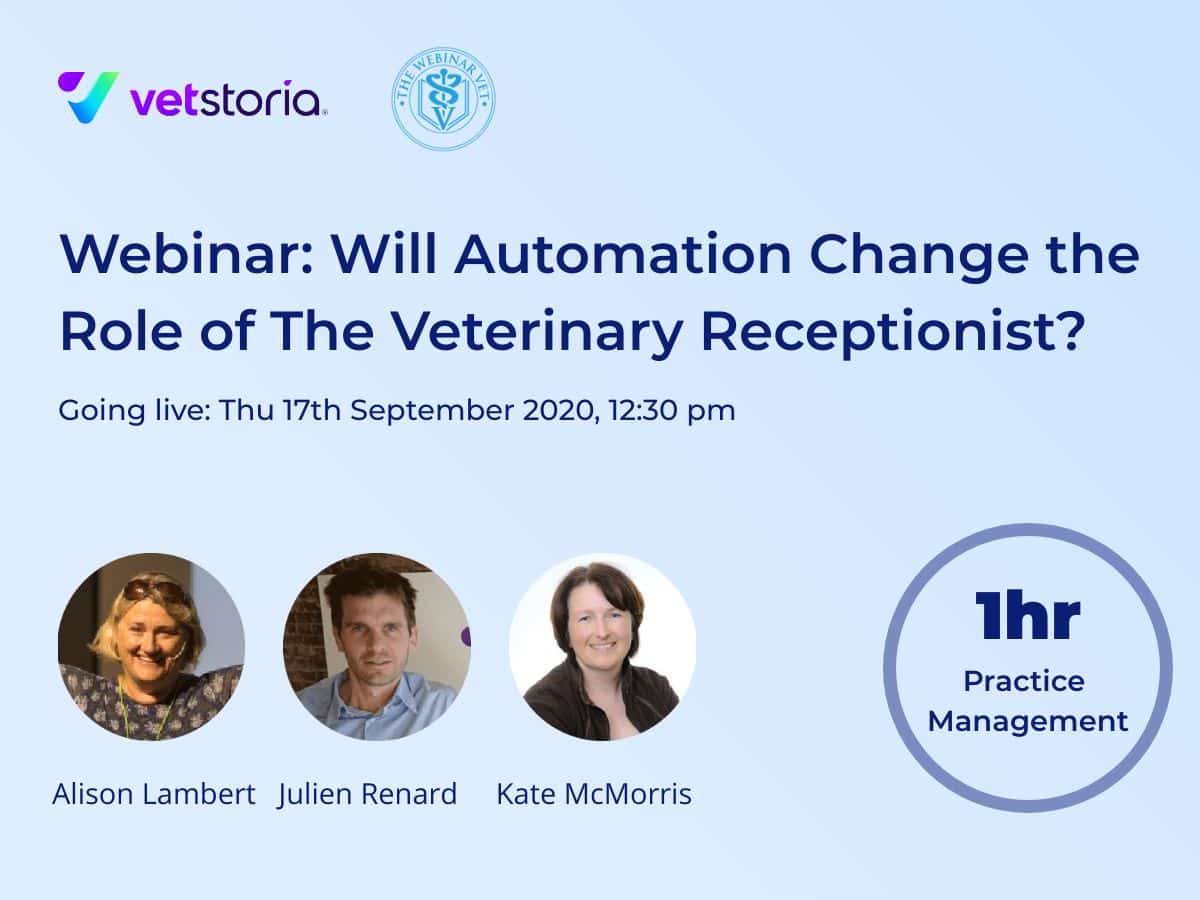
The Webinar Vet: Will Automation Change, The Role of The Veterinary Receptionist?
Thu 17th September 2020, 12:30 pm - 1:30 pm (BST)
Vetstoria will be hosting a very special round-table discussion on the popular platform - The Webinar Vet - with fabulous guests on the topic of automation and receptionists.
Click here to register for free on The Webinar Vet website. (More info below)
You don't need a paid subscription but you'll need to register with The Webinar Vet and set up an account to watch the FREE webinar.
Background
The automation revolution has been accelerated by COVID-19, which has sent many practices and pet-owners onto a steep learning curve to use automated technology.
Whilst the skills of veterinary surgeons and nurses (technicians) are hard to automate, the traditional role of the receptionist, as some practices have proven, is precarious. Will the role cease to exist or simply evolve?
Our panellists will address COVID-19's impact on the industry while outlining the most significant challenges receptionists currently face. They will then discuss how automation can support receptionists, and what that means for the role of the receptionist going forward, before opening up to the audience for Q&A's.
Meet our panelists
Alison Lambert - Co-founder - Onswitch
BVSc CMRS MRCVS

Alison is a well-known industry speaker and customer service expert who is also the co-founder of Onswitch, a veterinary business management consulting company. Onswitch exists to Inspire Change and create customer-centred practices where pets, equine and livestock receive the best care.
Kate McMorris - Veterinary Surgeon & Director - Seadown Veterinary Services
BVetMed, CertVOphthal, MRCVS

Vetstoria power-user, Kate McMorris, is a veterinary surgeon and director of UK-based practice, Seadown Veterinary Service. Kate's creative use of Vetstoria during COVID-19 ensured healthy growth and smooth operations for her practice.
Julien Renard - CEO & Founder - Vetstoria
DVM

Julien is CEO and Founder of Vetstoria, the industry-leading veterinary booking platform used by over 2000 practices globally to streamline operations, improve customer experience and maximise revenue. Prior to becoming an entrepreneur, he worked as an emergency veterinarian across Europe and the UK.
Watch it live
Register to watch the webinar through the The Webinar Vet platform using the link below:
PLEASE NOTE: unlike most webinars on The Webinar Vet which you need a paid subscription for, this webinar is FREE.
However, if you are already registered with the Webinar Vet and want to add this to your schedule, simply click "Add to list".
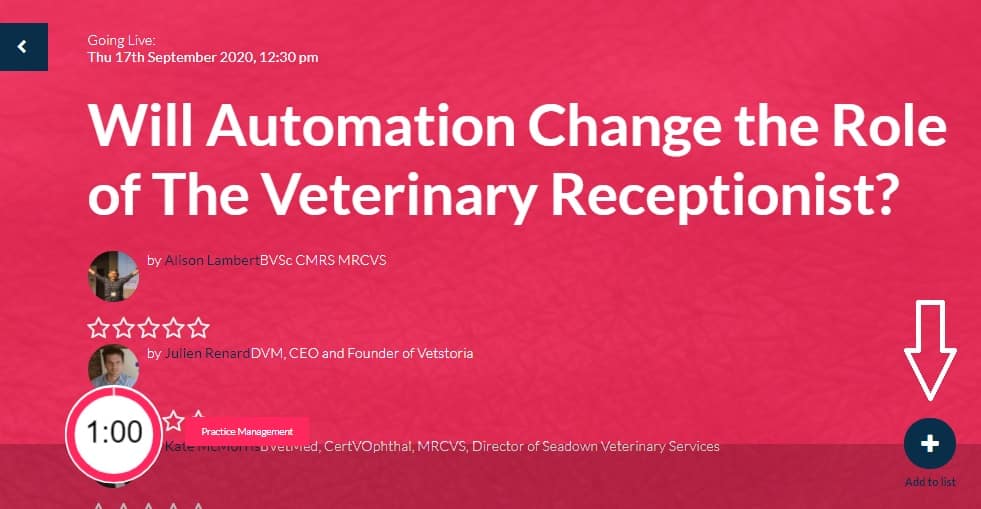
Once registered you will receive a link to watch the webinar live. And if you can't make the live viewing, the webinar recording will be sent to you after.


Why Happiness Equals Productivity Within the Veterinary Practice

An extensive study of happiness and productivity by Oxford University's Saïd Business School has found that workers are 13% more productive when happy. This is supported by economists at the University of Warwick who found that happiness led to a 12% spike in productivity. On the other hand, they also found that unhappy workers were 10% less productive.
Generating happiness among employees is considered very important for any business's performance and survival. Because happier employees work harder, cooperate better in teams, and as the results above show, they are generally more productive. It's as simple as that!
Free Download: Veterinary Employee Happiness Survey Template
It’s no surprise then that some of the largest companies in the world have started placing more emphasis on employee happiness. Take Google for example, who as a result of employee happiness initiatives, experienced a 37% rise in employee satisfaction.
This begs the question: in one of the most emotionally draining and hectic work environments, why is there not more emphasis placed on employee happiness within the veterinary practice?
Let’s face it, isn’t life better for everyone when we’re happy? For practice owners and managers, just taking that extra time and effort to ensure the happiness of all employees can make a huge difference. Happier, more productive staff and the resulting improved pet owner experience usually equates to more revenue too!
So why are practice staff more productive when happy?
Happiness breeds loyalty
A positive practice environment with satisfied employees usually leads to increased employee loyalty and retention. This means your practice can avoid spending time and money on hiring and training new team members. Not having to train new employees also reduces the workload of existing staff, in turn improving efficiency.
Did you know that employee appreciation plays a significant role in gaining loyalty? We found some results in a survey carried out by Boston Consulting Group which showed that there is only one simple thing that employees want from their jobs, “appreciation”!
Furthermore, loyal and happy employees are more punctual and have fewer instances of work absence. They are dedicated to what they do, willing to go that extra mile, and are generally more productive.
Happy employees care for the practice
Happy employees are normally the ones who embrace the practice’s goals as their own and are driven to achieve them. Ensuring the happiness of your practice team (potentially through implementing employee happiness initiatives) will increase the likelihood of them caring for your practice like it’s their own.
When employees are happy they are more compelled to work to their fullest potential. They feel invested in the practice's growth goals. Happy staff are also more responsive to the needs of customers.
Happy employees are healthier
Unhappiness and stress at work can lead to burnout and mental health issues such as depression and anxiety. Not only are these causes for concern for the long term health of staff, but also lead to increased absences, potential legal issues, less productivity within the practice and decreased levels of customer service.
As published by Safe work Australia, a workers' healthy regulatory body, Australians claim approximately $480 million in compensation for mental health disorders that relate to work every year, accounting for around 6% of total workers’ compensation claims. They further concluded that employees going through extreme depression take 20x more sick days each month.
Happy employees are more likely to stay healthy, be positive and contribute more towards the healthy growth of the practice.
Success is not the key to happiness. Happiness is the key to success. If you love what you are doing, you will be successful.
Albert Schweitzer
Happy employees make more money for the practice
Most veterinary practice owners and employees are not driven by money but rather a passion for animal care. But practices are still businesses that need to turn a profit. And one of the best ways to increase profit may well be by ensuring happiness across the practice.
A study that examined companies listed on Fortune's '100 Best Companies to Work For' between 1998 to 2005 found that companies on the list experienced a 14% increase in stock price on average, compared to an average of 6% for companies overall.
Considering that stock price usually indicates better business performance and that one of the key criteria for membership on the '100 Best Companies to Work For' list is employee happiness, it's safe to say that happiness positively impacts business performance.
How can you increase employee happiness?
We've highlighted four ways employee happiness can boost productivity and benefit the practice. But how do you go about proactively increasing employee happiness?
Here are five actionable changes you can make to increase the happiness of your practice team:
- Offer emotional support: As rewarding as they can be, veterinary practices can be emotionally draining environments. By taking 5-to-10 minutes each week to have a check-in with all team members individually, you will show them that you care. This helps to identify any issues quickly, and maintain a friendly, positive work environment.
- Pay employees fairly: Although most practice management will claim that they pay employees fairly, if the employees don't feel that way, they may feel underappreciated and unhappy. You may not be able to change the company's pay structure drastically. But if you have some control over budget and can afford to offer that little bit more, it's worth reviewing salaries (the most common is on an annual basis). Underpaid employees may leave for better offers, causing recruitment headaches.
- Provide feedback (positive or negative) with useful advice: If you want happy employees, you may be hesitant to provide negative feedback. But that doesn't bring employees happiness; it causes frustration. Your practice team wants to know how they are doing. As long as you give suggestions about how they can improve, your team will embrace the feedback and strive to become better.
- Reward excellent work with promotions: Some management teams are more concerned with their own career progression than that of their team. You want all employees within your practice to thrive. By helping them, you keep them motivated, working more productively, and enhance your reputation as a developer of people. Don't be afraid to offer promotions and more responsibility.
- Remain polite and professional: This seems obvious, but so many practice management teams neglect this. You don't need to rule with an iron fist to assert authority and get results. Treat people nicely, be fair, but be firm. Your team will appreciate it with more productivity and a better work attitude.
- Encourage workplace wellbeing: Most practices think that the wellbeing of an employee is something the employee alone should take care of. Not really! Employee well-being (emotional, psychological, personal values) and job satisfaction drive productivity.
- Build morale - teambuilding events: First concern when it comes to organizing an internal event is the cost for the event. What a lot of practice managers don't know is that a happy practice makes more revenue than an unhappy one. There are plenty of events a veterinary practice can organize to create good co-worker relationships and of course, have fun. Some examples are movie nights, game days, team lunches, Karaoke nights. Even a pet play day will help all employees bond and know each other better.
So there you have it. Employee happiness is vital to any business and should not be ignored. The productivity benefits are huge. Customers of your practice will feel the difference and your practice will be better off for it!
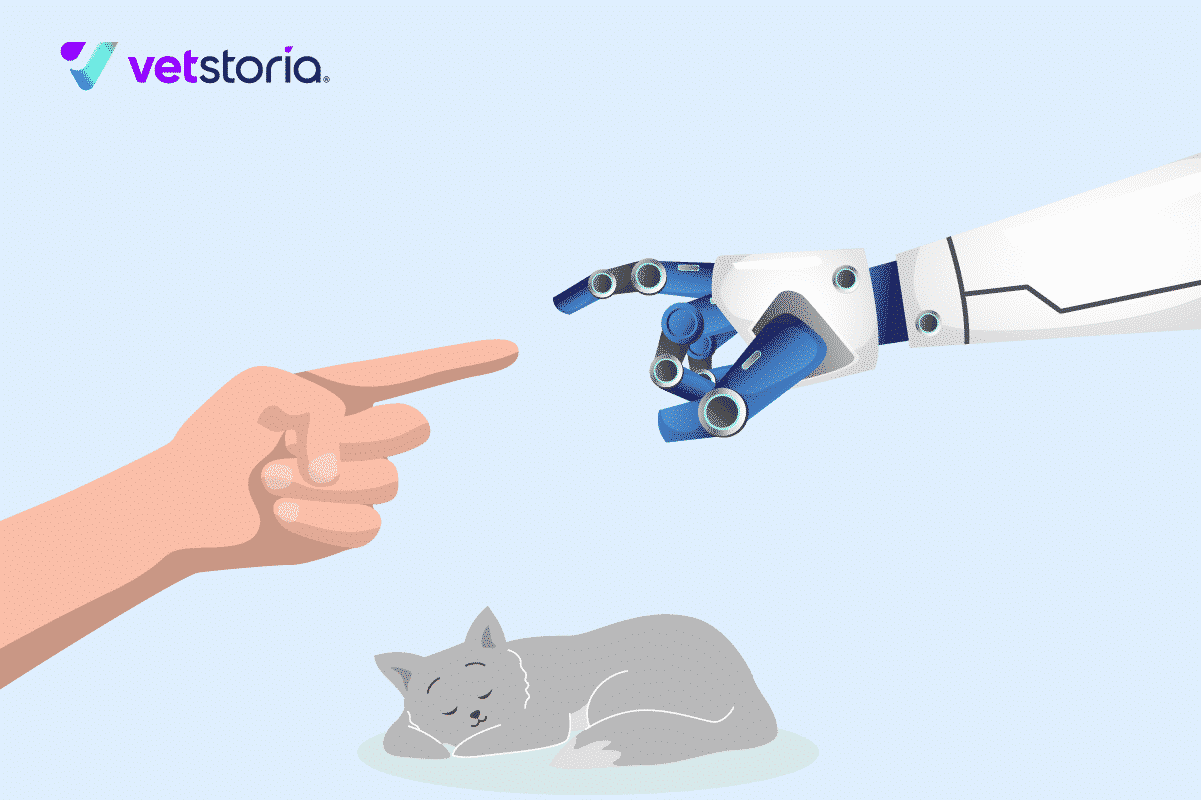
Weaponizing Automation against Recession

It’s remarkable how fast the strange and impossible become routine. For many shoppers, hard-working supermarket workers in their familiar uniforms have been the only humans they’ve seen in lockdown. Some countries (such as the UK and Spain) even clapped for them on specific days of the week.
Some of those workers may have feared for their jobs when self-checkout machines emerged in the early 2000s. Luckily for all of us, automation didn’t wipe the smiles off their faces.
Economic recessions historically inflame anxieties around automation. It’s alarming to know that the recovery from WWII, the Spanish Flu, and the 2008 financial crisis was not primarily down to creating more jobs. Instead, it was the advancement of automation that fueled such recovery.
Companies strive to cut costs during economic downturns by “trading down”, opting for a leaner, more productive, and less labor-intensive workforce with the help of technology. Why employ six team members when you can operate with five? But is this the right approach for veterinary practices?
How th e veterinary industry moves forward with automation
The jobs of veterinarians and technicians/nurses are hard to automate but that is not to say all veterinary jobs are safe.
A 2016 study found that “workers in occupations that pay less than $20/h are at high risk of being replaced, while the corresponding figure for workers on $40/h is only at 4%”. This finding places veterinary receptionists and some practice managers in the high-risk category unless management adapts their post-COVID workflows to embrace the value they can bring.
After COVID-19 passes, veterinary practices will want to pandemic-proof their operations, which means, those labor-intensive tasks will be driven out of the practice and the front desk where people cluster will see its activities reduced to the bare essentials.
The virus is likely to change pet-owner behavior and alter social interactions in a way that’s similar to how some customers already prefer automated services to personal interactions today. Those who are normally “stand-offish” will continue to practice social distancing despite the official policy changes.

It’s clear that practices that are ready to embrace automation will have the upper hand in safeguarding their employee's jobs, including receptionists, as automation can’t replace the human touch. However, automation will cater to a large portion of clientele who prefer to get things done without human interaction - a category many Millenials
Automation will undoubtedly drive long-term prosperity within the veterinary industry. In veterinary practices, however, pet-owners will continue to expect personal service, human touch, and empathy which technology can’t replicate. Vetstoria understands that, which is why our platform was designed to enhance the human touch rather than replace it.
How Vetstoria Helps
By using Vetstoria's platform with features such as online booking, online payments, and hosted video consultations, your practice can streamline repetitive manual tasks to maintain a competitive advantage and ultimately protect jobs.
Wanna see how it could work for your practice? Book a FREE 1-to-1 personalized demo with one of our product specialists today!

How to Overcome 4 Common Objections to Spaying & Neutering

The Sterilization Conundrum
It has become increasingly rare to see an intact adult dog or cat come through the practice doors. Vets are so accustomed to spayed or neutered critters that an intact animal is quite noticeable, and these animals aren’t constantly straying or rescued. Some were purchased as puppies or kittens from breeders and just never altered. With all of the known benefits for spaying and neutering animals, you may be wondering why we never see intact adults anymore. Well, some clients have their reasons. Let’s look at a few of those reasons and how you can hopefully address them to change their minds.
Free Download: 5 Veterinary Time-Saving Checklists
1. The cause of obese due to spaying and neutering

Many pet parents express concern that spaying or neutering their dog or cat will create this obese, lazy animal that wants nothing more than to eat kibble on the couch. While I can’t deny that that’s not something a pet would want to do anyway, spaying and neutering do not affect an animal’s activity level.
You can convey to them that, yes, the removal of certain sex hormones can increase the potential for weight gain. It shouldn’t change their personality or activity level for the worse. Let them know that, on the contrary, behaviors such as aggression, roaming, and marking can be reduced by spaying or neutering. They no longer have that drive to fight for or find a mate and guard their territory with such vigor.
Weight gain is a result of too many calories and not enough exercise. Even intact dogs and cats aren’t immune to that. If weight gain is the concern for not altering a pet, take this opportunity to emphasize the importance of healthy nutrition and exercise for all critters.
2. Chance to litter lost by spaying and neutering

Every once in a while, I’ve come across a pet parent that wants to have just one litter, puppies, or kittens, so that their pet/kids/themselves can experience it. Or maybe they’re even thinking about breeding as a side hustle.
This is an excellent opportunity to advise them on what responsible breeding is all about. Tell them about the pre-breeding screening tests that they should perform on the male and female, the potential health concerns with the mother and babies, and the possibility that they may not be able to get rid of the offspring.
Since most pet parents aren’t actively trying to increase the homeless pet population, they will usually reconsider when they find out the realities of breeding a dog or cat. They just weren’t aware of what it means to breed animals responsibly. Some of them also haven’t experienced a female dog or cat in heat, and discussing or witnessing that is sometimes enough to change their minds as well.
3. The Financial Fallout

Sure, there is a cost involved in the surgical alteration of an animal, male or female. The veterinarian and staff need to be adequately compensated for the instruments, time, and knowledge that goes into spaying or neutering. Unfortunately, we can’t give away sterilization procedures all of the time. While the upfront cost of a spay or neuter makes some pet parents balk when shown the realities of potential costs they can accrue if their animal is left intact will make the breath stop in their chest.
On one side, there is the cost of raising litter after litter of puppies or kittens. Those cuties need food, shelter, and medical care, not to mention all of that for the mama. Even if a pet parent can find homes for all of the babies, they still consume a substantial amount of resources before being weaned.
On the other side are the potential costs of something like a diagnosis of mammary or testicular cancer. The surgery cost for that will be more substantial than a spay or neuter, and the aftercare could be even more astronomical. Not to mention the physical and emotional toll something like that takes on a pet and its owner.
Remind clients that while the cost of a spay or neuter may seem large and scary when considering the alternative, it becomes more feasible to handle. It may also help to have options for clients to get financial help, such as a Good Samaritan Fund, payment plans, or other resources available.
4. Ligamental Leverage
With new evidence showing that intact animals are less likely to experience specific ligamental and orthopedic issues than those that are spayed or neutered before a year of age, it may lead some of your more informed clients to cite this as a reason to forego sterilization.
Indeed, hip dysplasia, cranial cruciate injuries, and other joint problems are more common in large breed dogs that are sterilized at a young age than those that remain intact. This is because reproductive hormones influence tendon strength, muscle mass, and bone growth, and if removed too early, it can lead to imbalances and weaknesses. It’s a viable concern, and you can approach it in a couple of different ways.
The first way would be to compare these issues with others that are more common in intact dogs-mammary and testicular cancer, aggression, roaming, pyometra, and of course, unwanted litters and heat cycles. While no one wants their pet ever to experience anything negative, you can show the pros and cons of each side, and they can weigh those as they see fit.
The other way would be to reach a compromise. If you’re faced with a client with a large breed dog, instead of letting them stick with not altering, delay spaying and neutering until after one year of age. This would allow that animal to reach puberty and maturity to no longer rely on those reproductive hormones to achieve balance in growth and development. A female will probably go through a heat cycle and, therefore, slightly increase their risk of mammary cancer, but I think most pet parents will see that as a fair tradeoff.
A final note
With every pet parent, it’s essential to discuss spaying and neutering at every puppy and kitten exam, as well as every new animal exam. Some clients don’t know or understand the benefits of spaying and neutering and think it’s something to help line the veterinarian’s pockets.
Letting them know these benefits in advance will better prepare them for the cost and the age at which these procedures are usually done so that they can plan accordingly.
You can also walk them through the details of the procedure, such as drop-off and pick-up times, as well as what to expect for the take-home, to settle any uneasiness they may have about the surgery itself.
If you have one of those clients concerned about the aesthetics of a neutered male, you can consistently offer up some prosthetics!
Whatever the reason behind a client’s hesitation to sterilize their dogs or cats, it’s up to you to provide them with the pros and cons of their choice and help them make an informed decision.

Veterinary Innovation Podcast with Vetstoria CEO, Julien Renard
What is the Veterinary Innovation Podcast?
Veterinary Innovation Podcast is where cool kids get their weekly dose of veterinary funk, which is why I was surprised to see our CEO Julien Renard on there.
Just kidding, Julien is the GOAT (greatest of all time) and I would say the same about Shawn Wilkie, and Dr. Ivan Zakharenkov who comfortably retired at 38 before creating this smash-hit podcast.
The trendy medium of podcasts usually relies on word-of-mouth to proliferate. That’s no problem for those guys though, because Veterinary Innovation Podcast has a stellar cast of heavyweight industry speakers like Bruce Truman and many more!
In this episode, the three entrepreneurs chat candidly about the challenges and rewards in starting up a tech company, dealing with different cultural sensibilities and ultimately how online scheduling for vets is essential for a modern practice to grow. Take a listen:
It is well worth the time of those who aspire to start their own business post a veterinary career, something both Ivan and Julien have experience in. For practice managers and owners looking to grow their business in the modern era, the trio put forth a perfect recipe for success, so don't miss out!
In the meantime, why not head over to Veterinary Innovation Podcast for more great podcasts?
Full transcript of this episode below:
SW:
-You are listening to the Veterinary Innovation Podcast
My name is Shawn Wilkie and along with my awesome co-host we interview the innovators in the veterinary space every week. I want to go in and introduce today’s guest.
IZ:
-Hey, my name is Ivan Zak, and I am happy to introduce you to my friend Julien Renard who is a veterinarian, who graduated from (and I’m gonna screw this up) From the University de Liege. How do you pronounce it again?
JR:
-Liege
IZ:
-Okay, that’s what I said. So he studies in Belgium. (laugh). So, he also studied business and management in the Brussels management school. He is the co-founder of Vetstoria; therefore we are gonna talk about online scheduling and anything that is innovative in that area. On a personal set of things, he travels a lot. He recently traveled to Orlando, New Port, sounds like probably a lot of conference traveling… Chicago, Paris, London, and New York (Yes, sounds like a lot of conferences). As the CEO and the founder of Vetstoria, it’s been, you know, we’ve known each other for I think over five years,
JR:
-Yes, at least
IZ:
-Yes, so, on a personal side of things also what I want about Julien he is from Belgium, and then but he resides in England, and he has accent in both languages. So it’s really hard to say which language is his native.
JR:
-The only thing I know is that it’s a very bad mix. Doesn’t sound good.
IZ:
-(laughs) No, it’s good, it works well in North America when you meet people. Very interesting statistic: on your website, that we noticed, it says that 52% of the appointments are booked outside of business hours. I think it’s really cool and I would like to probably open up with why is that important and how does that influence your product, and was it sort of the decision-making point.
JR:
-So this 52 slash 50 depends on the practice, sometimes it’s 48, doesn’t really matter. But 50% - and it’s been consistently number that we have from the start, so since day one, I mean the clients are booking hours for the appointment outside of normal working hours. So what does it mean it simply means one thing is that clients are willing to scheduling an appointment when the practices are closed. And this is something that we ask customer are actually doing every day. We’d like to know a little bit more about, I’d say customer experience and clients are expecting exactly the same thing, they have exactly the same expectation with than I don’t know, the hairdresser or the next plane to schedule online. So this is exactly what we provide. So we provide an online scheduling system for the practice and that would be available 24/7 per day 7 days a week. Really clients like to schedule when it’s convenient for them. That’s what we offer.
IZ:
-So was that the statistics that you found after you started the product or that’s something that you thought about to start the product?
JR:
-No, after. Honestly, we had no idea before starting, and we started pretty when one of the first ones starting at that luck, thinking about like five years ago, four years and a half ago, and we had no idea.
SW:
-What other interesting statistics have you learned like along the way about the use of your product?
JR:
-There is two additional data: one is the percentage of mobile users and that’s actually a data which is being chaning from the start. We used to be at 44-45% of mobile booking 4-5 years ago. We are now at 60 percent, so the mobile usage is definitely been growing, so that’s one aspect. The third data is really about new clients. Online booking is a key channel for clinic to acquire new customers. It’s very simple to understand, like all of us, if we want to use a new service or buy a new product, we are just gonna go online, check this, I mean “Do I like this product? Do I like the service?” , and then you have a call to action and you buy it or you schedule it or whatever. Well, online booking for vet practices is not different. The fact that you have a veterinary clinic is a better schedule an appointment online on the website. It allows them to transform a website visitor into potential new customer, into a customer which is making it very easy for them to schedule their first appointment. So this data is 17%, so that’s an average. We have clinics which are booking much more than that is new clients when I say much more we are looking double digit and starting by two. So we have clinic which are looking 25% of new clients. Usually it’s clinics who have a strong marketing strategy behind them. And I would say some of the cooperates are very good at that. Really, they put a lot of energy into acquiring new customers and we are piece of the acquisition puzzle they have been building. And we have clinics which are more like 10-12 because they make less effort. Or also, they have more existing clients scheduling. So, because they have existing I would say the percentage of new clients is dropping a little bit.
IZ:
-So let’s unwrap that a little while. Like you said about marketing, you know, this one of the passions of mine. When you are saying you a part of their acquisition model, you mean that when the clinics are sending out the marketing campaign. So, for example, for dental month or, you know, “Don’t forget your vaccination”, then the emails that they are sending, they would have you know, a description of the service that is suggested, or it’s a reminder, and then the call to action, which is the button in the email, leads directly to the booking page. Is that what you?
JR:
-So there’s two type of marketing. What you described is marketing for existing clients. You don’t sell dental campaigns to non-clients. So that’s marketing to existing client, typically vaccination reminder, which I would say what every single practice should do. But yes, you have dental..I don’t know, let’s say nurturing amnesty or things like this. But one of the key aspect is marketing to new clients, acquiring new customers. So that’s very much Google Adwords, retargeting, things like this, or social media campaign. And we can be a piece of this puzzle.
IZ:
-That's excellent. So do you see a lot of corporates using the retargeting and Adwords and things like that? Are they now tapping into that?
JR:
-It’s definitely opening. So some have started and some are starting, but for sure this is what’s very exciting about an online booking. Because as you are a bit the king of marketing, (laughs) So you know that marketing there is a big challenge is measuring the return on investment. For practice, they need to come tap the local marketing agency or whatever and then they start “Okay, give us a budget on this, and we are going to generate X.” The problem is that to actually F the final X it’s rather complex, because when people start driving online traffic, the last peace of the journey is you know you have to make a call to schedule your appointment. Well, when they can book online and when we can follow I would say the path of these clients, or from these leads, from the start, and you can know exactly how many new clients are being generating at the end of your marketing activity. It gives the practice a very precise idea of the return on investment. They know that they invest in X, and they know that at the end of the journey they’re returning X new clients. If they put in the equation the life-time of new clients, they know exactly if it’s worth the investment or not.
IZ:
-Yep, no, absolutely, that’s brilliant. And you are absolutely right. When I was looking out at a different solutions in the URL domain, in the online booking, there is the final call to action that actually determines that KPI of the effectiveness of your marketing. It used to be the phone ringing, and then nobody records it. And if you’re consolidator, you can’t count on phone call either anybody does that. So that’s brilliant. Now, you know, your story is very similar to mine, and you’re a veterinarian, just like myself. And then, we decided to shift gears and build something. And then all our relatives told us that we’re idiots, that we should go back to the veterinary
JR:
-Honestly said that
IZ:
-Mine did. (laugh) And then, especially my father in law. He said it’s a stupid idea, which was basically a guarantee that it’s a good idea. So yeah
SW:
-It’s a shoutout to your father in law, right? (laugh)
IZ:
-He doesn’t speak English, he’s not gonna listen to this one. He’s a good guy, he just doesn’t like workflow optimization tools that veterinary clinics cause he makes honey.
SW:
-Now it sounds like your wife may be listening to our podcast.
IZ:
-Well (laughs) I’m just, it’s just a safety..It’s like..So yes, when that story, you know, you change what you wanna do, then you pick this topic, and then you know, or this niche. And then you tactic through it. But you really sort of hockey sticks, started happening from sort of 2015 if I remember correctly or 2016. What was first of all that initial couple years, how did you fund it? Did you borrow money from your mom? Or your friends and family are fools? Or were you funding it by veterinarian. And then, what was that pivotal point when it started to improve, how did that feel?
JR:
-Well, I started the company with my friend Julien Poublon who I’ve met at the vet school, and exactly like you: we basically were working nights, doing night shifts and working on the vet store the day. We started working on the initial application we built it was a pet portal. It was a bit like a pet desk vet tool, vet’s application. It was before that, and probably wrong timing, and we probably have not executed the product as we should. We had a customer, but attraction at least in UK was not great. I mean yeah, we had customers, but the growth that we were planning to have was not there. And we simply had requests of clients who were like “okay, by the way, it would be great if you had an online booking in your application”, and we just said “okay. It sounds interesting”, and we simply built it. But what we did at that time - it was a smart move at that time, I’m quite proud of myself or of the team, I’m not alone there. We actually built it as an, and potentially it could be used separately. And what we saw is simply the traction on the, that booking tool was, I mean at a completely different scale than what we had on the pet portal. So I’m not saying that the portal is not good, by the way, I think it’s very very good. But the way we did it - at that time - was not the best thing we did. We did the online booking and we learned from the previous mistake. There is also one thing was also challenging at that time, you know, in the US. There is the data and there is no data point. We went to UK, and in the UK there is no vet data or data point. So we had to convince the practice management software to actually work with us, build a API to work with us. So it was a very long journey because we had to convince all of them one to one to be learned API.
IZ:
-I’ve been on that journey with you. It’s a..
SW:
- It’s a recurring theme on this podcast, isn’t it?
IZ:
-Yes, we definitely struggle with that. There is a lot of one on ones that we built before the vet data or data point existed. But you know, that’s a really interesting path. And then what I also know which I’ve never tapped into. You went different languages, too.
JR:
-Yes
IZ:
-Maybe that’s because you are bilingual, but you went languages that you don’t speak.
JR:
-Chinese?
IZ:
-Chinese? Are you an Asian?\
JR:
-Yeah (laughs)
IZ:
-Wow. So yeah, there is, you know, your global distribution is quite fenomenal. So your biggest market as far as I remember in the early days was in Australia.
JR:
-Well yeah, it was actually Holland. Holland was interesting because we sta..so we went where we had partners, and IDEXX Animana who was Australian based software, and IDEX Animana, which is in the Holland, were kind of our first two partners. And we just went there. So interestingly, Holland is a very interesting market to test - features and products - big companies such as LinkedIn, for example, are testing new features in Holland. Probably the way people use technology there - it’s a very small country - there is a lot of practices, there is a lot of people there. And there is a lot of competition in between vets. So it was a very interesting market simply because there was a lot of traction there. Vets are very well-engaged when it comes to marketing.
SW:
-That makes me think of a question that It’s kind of a burning question for me and Julien. I’ve been in and around the circuit in the last 3 to almost 4 years now. And my favorite boothmates are these marketing companies that are unbelievable in the approach, very persuasive, I heard them described by people as across between use care sales person and the worst person they’ve ever met. And I just like..I don’t know.. I don’t want to say any company in particular. I think, you know our listeners know who they are. But I’d like you to comment on that. You know, your inside on that. How does a veterinarian see through the fog of all of these people that want to sell them a templated website for 5000$ to 10 000$, and get some real assistant that can drive dollars to them bottom line . Do you have any suggestions because what I see I don’t really like and I’m just wondering if you get comment on that.
JR:
-To be honest, I mean, we’ve been discussing this with Ivan quite a lot recently. I mean it’s always the problem of marketing. I think it’s back to what I was saying earlier. When we give the tool to a vet, or to any business to actually measure the return on investment or day marketing activity, I think it’s pretty straightforward, okay? If you know that you can actually see how much you are generating, the practice can make the decision themselve. The problem with marketing is that when you don’t know actually how much you are going to get at the end. So for me, the only way to resolve this is through data. When you can provide the data, showing actually and proving that you’ve been delivering, nothing can go wrong. When the numbers out there at the end, for me that’s the only way really to actually avoid these kind of issues.
IZ:
-Well, sometimes it’s hard to maybe design up front. And good marketers can say that this is the return on investment. When they tap into a new niche, and these guys, you know, they’ve been around, the ones that you are talking about, Shawn, but if someone comes in to the new industry, they may not know the exact response of their audience. But very quickly, when they start, as long as they measure the right things, you can understand are you doing the right things or not. Cause the worst thing is you know marketing before sort of the 2000s. There is a marketing budget that you have to just spend, and you print, you know, envelopes, give pens away at the conferences, have zero understanding where these money goes, and then the only way in a clinic to understand is when your phone rings, which nobody records the quantity. So really you are just wasting money on, you know, your kids football team T-shirts and, you know, stuff like that, that has no any impact or relevance, and then you just hope for the best. So right now, in digital age I think it’s neuroscience, data-driven and can approach it otherwise.
SW:
-And I agree with all of that stuff, and I think what I’m trying to dig at and either one of you guys answer this question if you can for our listeners is how do they pick a good marketing company? Yes, sure, data has to be data-driven, but there is so many companies that want to sell these unsophisticated marketers, which are some of our listeners, they want to sell them at 10000$ website and 10000$ is a lot of money, and there is no other why. So how do they even go about assessing those companies to make sure that they make good decision and then have a return on that investment. Any suggestions?
IZ:
-I think references. That’s really.. If they have been around for a long time, ask their clients to tell about them. And then ask smart questions. I don’t know..
SW:
-No, I like it. That’s good.
JR:
-Yes, I agree. Plus data. When you start, when you have picked up your favorite goals, you just go for it. And then, I think also probably the expected timeline to see result should be fixed from the start. Okay, these are 1,2, or 3 KPI that we would like to achieve in 3 and 6 month. And if you don’t achieve it, you have to take necessary decision.
IZ:
-Yeah, you have to..
SW:
-I would add a third thing to. Like, you know, just follow the three quotes thing. Get a couple of quotes or don’t take that offer just because some is pressuring you to take it. Yeah, this is interesting observing over and over again as it shows in the last couple of years
IZ:
-But the other thing, Shawn, is when you are taking sort of or doing the experiment with some sort of company, after you collecting you references, after, you know, you had a conversation with the sales person. You need to start, you need to set limit, and then you need to cut it if it’s not working. But the important thing is that I was just talking to the CEO of a manufacturing company, a friend of mine, and he said that.. He doesn’t know much about digital clinics. Socks. He owns a factory, he makes socks. Does billion of them. But then I was talking about marketing with passion about it, and he was like “Oh, marketing is the first budget that we cut. He’s like these losers are hiring one and then after two months nothing changed. So you really need to stick with it, because if you’re talking about true digital marketing with the effects of it, you need to look about 6 months to see the return. And the proper, you know, SEO propagation, and the link engine, like all of those things to collect data. But then, after the six months, if you don’t have the result, you have to cut them loose and, you know, use someone else.
SW:
-Okay, so that was great.
IZ:
-Cool. So, so I wanted to kind of, you know, talk a little more through the international experience. Because I’ve been on this talk, and someone invited me to talk about the global expansion of the company. They invited me and they said “Can you talk about penetration of the global market.?” And it was all those guys who’ve been working in the big companies and they wanted to know how you know these strategies build to go global. And then, as a start up, it sounds like Julien, your story is similar to mine as I was, you know, my story was..I was sitting in the demo, someone booked a demo with me, and then I heard a funny accent, and then after you know, at the end of the demo, I found out it was an Australian guy. And then at the end he said “Where do I put my credit card?” And then now we have an international you know Australian customer. All of the sudden, you have to build support, you have to build sales, you have to now support that market. So I think that the big company perspective was you throw an idea that you know we are gonna penetrate in Australian market, and then you build a plan and the strategy around it, you do the budgeting, and then you deploy this, and you need to do that. And then in reality, when your agile startup, you kind of go with the flow. You really get your customers, and then if you.. You know, if it bites, then you start building infrastructure out.
JR:
-That’s totally the case. I mean ..As I say, the first step was that we actually worked there and the main condition was we need to have the PMS that we can integrate with. Then, getting a few customers. All right! Do they like it? And when we ever prove that there is actually a market there for us, we set up the strategy around that isn’t sales and marketing.
But absolutely. It’s much less planned, and
(Indistinct speech)
JR:
-Yes. Well, actually, to be honest, for example in the US, you know in the US now we have much more strategic approach now because we used to sell from the UK, but now we’re setting up an office in Texas, and I would say for that kind of market we are thinking and planning much more strategically than what we have done in the past. I mean there are countries which are less important. We have customer in Chech Republic..
IZ:
-I have a friend from Chech Republic. He’ll tell you how less important.. (laughs)
JR:
-So I’m not saying it’s not important. I’m saying for her that targeted country there is probably a little bit less potential, let’s put it this way.
IZ:
-Yes, no, and that’s .. we never close the doors to any country.
JR:
-Same for us
IZ:
-No, you’re buying our software and use it. And, you know, we’ll have a limitational support in your language if you’re okay to use it, you’re welcome. And I know that you know some companies, because of the infrastructure, they have difficulty doing that, but with the global availability of just put the credit card, even if you are in some foreign country that doesn’t support your payment system. But payment system will take dollars, so just do it. I think for any startup, instead of trying to think regionally and stuff like that. Because the one thing that I found about Australians is that just like you said about Netherlands. We never got to Netherlands just because we were afraid of language, but Australia was very interesting, again, they were super eager and fast decision-makers. Compared to Canada, I think that I find, unfortunately, I live in Canada and I love Canada, but they’re such terrible decision-makers. Sorry, Shawn. They, you know, they will be like “Oh, that’s great, and you know, we’ll think about it”. Australians - that’s the only country where they say “Where do I put my credit card in?”. And that was important to us.
JR:
-I agree. And same for the Dutch. One thing that is interesting actually working internationally like this is seeing a difference of setup and different way vet practice actually work. There are some big, big difference. I mean, for example, you know, if you’ll look in the US clinics, US vets are usual duration of consultation minimum 20 minutes but 30 minutes is extremely frequent. If you come in the UK, most of the practices are on the 15 minutes duration consultation. So this some big difference..I mean when you talk about an hour of the time, you can imagine the number of consultations for vet is pretty different at the end of the day. So that’s some key differences that we have been observing, and yeah, there is a lot of differences between the countries.
IZ:
-Would you mention about the difference in how they practice medicine? That’s also important when you are building your technology towards that. Cause you can really in a workflow optimization, when we built smartflow. When we came to Netherlands ,and especially in the UK, you know, they have shorter appointments, but at the same time, the big difference that I kind of got burned on, cause I was pitching you know with the way I’m used to practice, and Canada and US is similar, where we send a technician, or nurse into the exam room first. Well, in the UK that’s not the case. They just go in.
JR:
-That’s correct
IZ:
-There’s a truly the engine that work in the back of the clinic and that’s the workflow perspective. It’s extremely important. I was trying..First, two London vet shops, I was trying to convince them that this how you optimize your technicians in the room, and they were like “Well, we don’t send those..
JR:
-We don’t do this, thank you very much
IZ:
-Exactly. And then, in South Africa, I don’t know if you have any practices there. It’s completely different flow. They have like these grades of assistance and technicians. They have a whatever you call them like on the uniform. Like, he was different, and then, you know. Yes, it’s medicine, but the whole flow is different.
JR:
-And also the size of the clinic. I mean, you have. If you go in Germany, the majority of the clinics are 1, sometime 2 vets. You know, if you go in Sweden, it’s much bigger practices. So that has a direct impact on the workflow and the way consultation is delivered.
IZ:
Thank you so much for listening to the Veterinary Innovation Podcast. If you want to hear about our new episodes, please follow us on any social media channel. Also, you can check our website at veterinaryinnovationpodcast.com. See you next week.

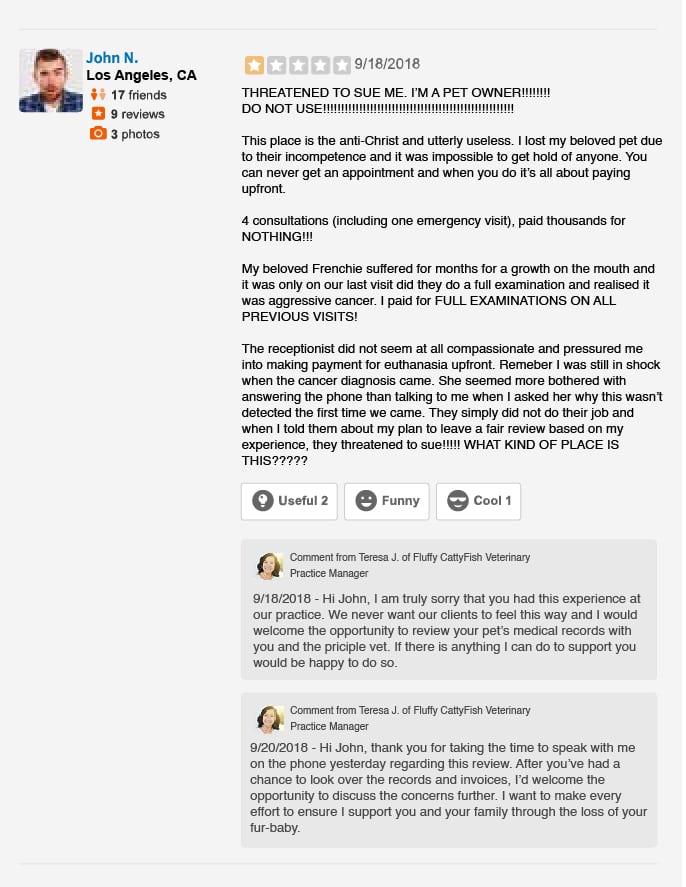
Is this the Worst Review a Vet Can Receive?

What a nightmare! I mean...
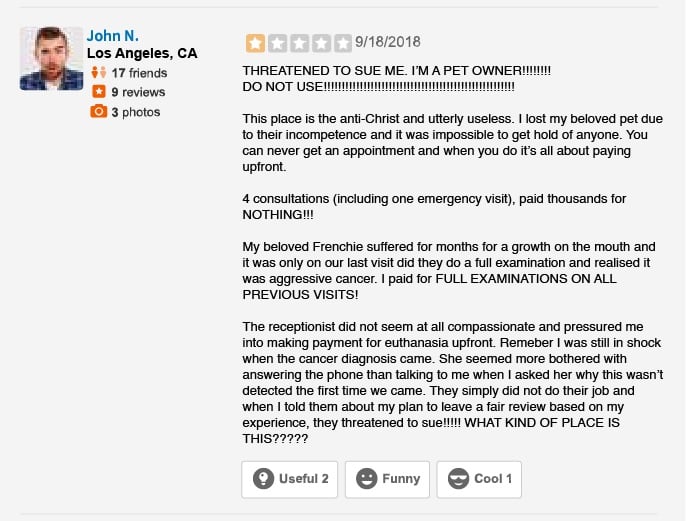
My heart really goes out to John as this does sound like a horrific experience. However, I'm sure many of you can empathize with the practice’s position regarding getting the payment upfront.
It is a commonly implemented policy and there’s no magic solution to do this without coming off as insensitive, especially when a pet is being euthanized.
Furthermore, it's not unheard of that a pet owner is taken to court over a negative review.
In July 2019, a Yelp user in Florida named Tom Lloyd told “CBS This Morning” that he was left with more than $25,000 in legal bills after a veterinary practice sued him for defamation over a negative Yelp review. In the review, Lloyd recounted how his dog died at the animal hospital waiting for a surgeon who never showed up.
Intimating a pet-owner into retracting their story is not a sustainable or scalable way of handling reviews. It doesn’t represent the compassionate nature or professionalism that veterinary medicine bestows on its people.
My advice is to always diffuse the situation and sort it out offline if possible. As far as a response is concerned, I actually think Practice Manager Teresa handled the situation well.
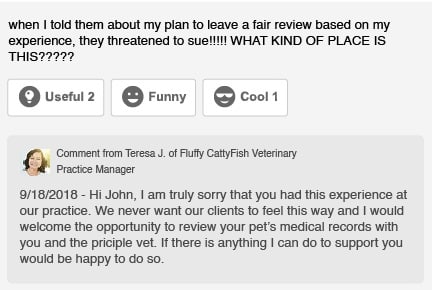
When pet owners mention money, it’s never really just about the money. Most of the time they just want to be heard. By offering a chance to speak, it stops the escalation of the whole issue which is a favorable result.
Want to know more about handling negative reviews from a mental and practical standpoint?

How to Deal with Negative Online Reviews (5 Tips for Vet Practices)

One star does happen!
You’ve been extremely happy with the way your promotional efforts have spread the word about your veterinary practice. In fact, the bell on the practice door has been ringing seemingly nonstop with new clients coming in. While it may be all the glowing online reviews that have these new clients completely ‘star struck’ with your business, your great service has backed that online reputation.
Learn how you can grow your veterinary practice with online reviews.
Suddenly, among all of those four and five stars, a one-star review rears its ugly head. If you’re like most veterinarians or practice owners, the law of averages doesn’t apply. One bad review definitely outweighs all of those positive ones, even if your average barely suffers.
How you handle that bad review may influence how prospective clients view your veterinary practice, as well as how many more negative reviews find their way in.
With that said, here are some tips to help you better deal with negative online reviews (should you ever need them):
1. Take a timeout
When faced with a negative review, the initial step in handling it is first to catch your breath. Believe me; it’s probably going to take you back a little bit, especially if you’re used to only reading praise on your review page. Before you decide when and how to respond to this negative comment, you need to get into a relaxed headspace.
No one wants to read the angry rants of a bitter practice owner that just received some nasty news, let’s leave that for daytime television.
Give yourself some time to get over the initial shock and anger and into a better temperament where you can address this client’s complaints head-on, yet rationally.
While it is definitely important to respond to reviews as quickly as possible, a little delay will be worth the wait if you come back with a cool head and are able to respond like your back’s not against the wall.
What are some of the worst online reviews you've ever seen? Take a look at this one.
2. Respond publicly then move offline
Once the redness has faded from your face and your body temperature has dropped back to 98.6, respond directly to that negative review, right there on the review site on which it was posted. Apologize to the reviewer that their experience was less than what they considered ideal.
Hold off on apologizing directly for whatever it is that you are accused of.
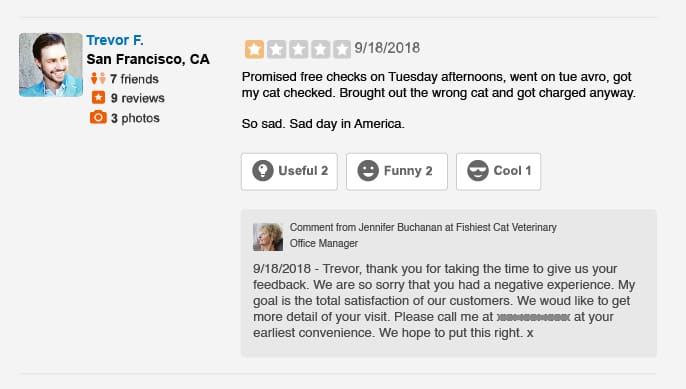
Ask that reviewer to kindly contact you privately at their earliest convenience, providing contact information, including the name of a specific practice representative, if possible. And then sit back with your fingers crossed that they do return the call.
The reasoning behind moving the solving of negative reviews offline is simple. Trying to fix everything in one electronic response can often do more harm than good.
Even if you never hear from this person again, you have let other potential clients know that you care about your client's experience when they use your veterinary services and that you want to investigate their case in further detail to make things right.
3. Remember the "client is always right"
If you get a private response from that reviewer, then it’s time to mend some fences.
Even if you believe the client to be in the wrong, remember that the "client is always right" in services businesses, and reputation is everything, so guard it!
Apologize to the client for their unpleasant experience, calmly address their concerns and offer a solution to their problem. Depending on the situation, you may want to explain practice policies or procedures that may have caused this experience to occur.
In most cases, an apology, explanation or solution to the initial issue will be enough to satisfy a disgruntled client. But not in all cases.
Even if you believe the client to be in the wrong, stay calm and professional and let them know that they're being listened to. As long as you show effort and desire to resolve issues, most clients will be appreciative and feel well looked after.
4. Offer something complimentary
There will always be cases of "difficult" reviewers that are not satisfied despite your best efforts to apologize and address their concerns.
Some will even persist to leave negative review after negative review on various channels to display their anger.
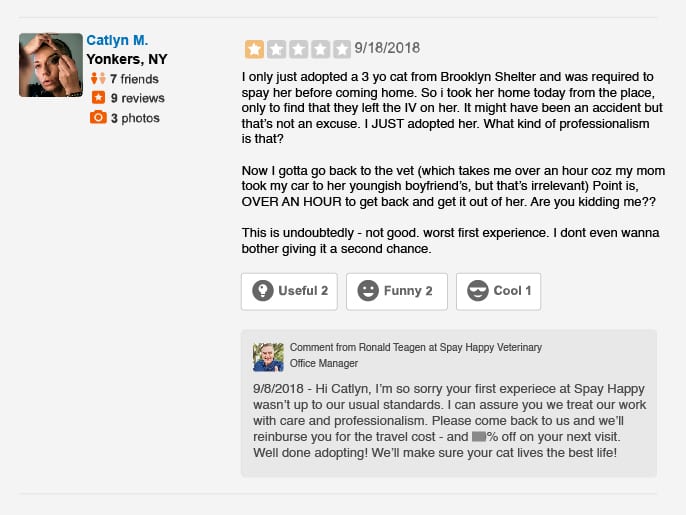
While it is something that you may not necessarily want to do for every dissatisfied client, offering a complimentary item or service is a great way to show how "sorry" you are and how seriously you take their complaint.
Perhaps it's a discount off their next vaccination or a free toy for their furry friend, a giving gesture can go a long way to converting a potential detractor into a loyal evangelist. Who knows, they may even refer their friends and family to your practice, generative a huge return on your "complimentary" investment.
5. Revisit the review
Even if they don’t remove the negative review, you can revisit it and update other readers that an agreement was reached with this client and the seas are calm once again.
In a perfect world, all interactions would turn out this way, but let’s get real. Sometimes there will be no amicable conversation and no agreement. Instead, there may be an already upset client that remains that way and takes their business elsewhere.
You can either let the review stand or you can revisit it and give others a little insight into the situation.
I’m not saying to make it a full disclosure explanation, rather provide a brief description of the misunderstanding, again, without placing blame. You may express your displeasure on the inability to reconcile as long as you can keep it professional.
Summary
Don’t let negative online reviews force you into a dark hole of self-pity, instead use them as a springboard that launches even more new clients toward your veterinary practice.
First and foremost, respond to them. Don’t let them sit on your review page like a scarlet letter. Always maintain your professionalism and your cool when responding to these reviews.
You want to appease this client, but you always want to appeal to prospective clients with your compassion for the work that you do and your practice’s reputation.
No veterinary practice is going to maintain a perfect five-star average for long, so use those negative reviews to bolster your business rather than stain your status.

Saved by Pain Scoring Charts: A Veterinary Technician's Perspective

Objectifying pain assessment is a must
When working with animals, we lose the ability to ask our patients what hurts. We often have to gather clues that suggest an animal’s discomfort, and basically play detective in an effort to get to the source of their pain and what possibly caused it.
Due to this, it’s imperative that we know how to accurately gauge our patient’s pain so we can help to bring them relief.
With working in emergency medicine for the last 5 years, I’ve seen an endless amount of cases that require precise pain management and assessment. Some have been so vital that they've changed the courses of treatment drastically.
Free Download: 5 Veterinary Time-Saving Checklists
Working as a vet tech in Cambodia
Pain scoring charts have been used for quite some time in human medicine, but are still fairly new in veterinary medicine. Since pain can be subjective to each professional that may be assessing an animal, a pain scoring chart helps to make this process more uniform.
I experienced just how beneficial pain scoring charts can be during my time working at a veterinary clinic in Cambodia. Though you expect clinics in this part of the world to be a bit behind when it comes to medicine, treating a patient’s pain should always be at the top of the list.
When I first began my work at this clinic, their physical exams consisted of a quick run over, a standard vitals check, then hospitalizing them according to their obvious symptoms. There wasn’t any digging involved, no pain or symptom scoring, which likely left a lot of patients with their discomfort unaddressed. This also left a lot open to interpretation when it came to each vet that was involved in the animal’s care.
We then had a deep discussion about addressing symptoms that weren’t always obvious upon immediate examination, and that’s when a pain scoring chart was introduced to their protocol. We started with a cat that had been hospitalized due to severe gastroenteritis.
He was experiencing vomiting and diarrhea initially, but still refused to eat even after his symptoms were resolved with anti-emetics and GI antibiotics.
By using this feline pain scale the veterinarians were able to understand that curling up in the corner of a cage, hissing upon palpation, and disinterest in food weren’t just signs of being stressed in the clinic but could point to severe abdominal pain. After starting this furry friend on Gabapentin every 8 hours, he was digging into his boiled chicken and rice like no tomorrow. Thus was a clear example of how addressing a patient’s pain can be a huge step in their recovery.
The clinic now uses a pain scoring chart in every single one of their physical exams, and I am certain that their patient’s recovery processes are sped up due to this! While we have access to more advanced technology in the western veterinary world than this Cambodian clinic does, it shows you how a simple chart can have a huge impact.
Pain scoring chart recommendations
Think of a pain scoring chart as a way for you to advocate for your patient. When answering specific questions on the appearance of your patient, the main source of the pain can become more clear and help your patients receive the care they need. With that being said, you’ll need your pain scoring chart of choice to touch base on the things that are most important to you during your physical exams.
I prefer the pain scoring charts released by Colorado State University, as they go into great detail on the animal’s temperament. They leave little up to interpretation when assessing certain reactions to palpation, making it easier for everyone to be on the same page when they are tracking a pet’s recovery in the hospital.

As you’ll likely see when exploring online options, not all pain scoring charts are created equal. For example, this pain scoring chart for cats below is extremely broad when discussing a cat’s reaction to palpation.

The above diagram asks you to gauge the shape of the cat’s muzzle as an indicator of pain and includes a quick jump from unresponsive to aggressive when assessing their temperament. The answers to these questions could easily differ from doctor to doctor and can result in a cat not receiving an accurate pain assessment. When it comes to grading a cat’s pain, this scoring chart won’t get you very far.
The best pain scoring charts will have detailed descriptions, leave little room for confusion from doctor to doctor, and have a wide range of reactions to choose between for the most accurate results. When deciding on the best pain scoring chart for your clinic, make sure to look for:
- A minimum of 4 levels of pain to distinguish from and compare details
- Detailed reactions explaining responses to palpation of a surgical site, wound, or painful area
- Insights into body language with and without being touched
- Body tension and how animals attempt to guard their pain
- An area to leave notes for other vets or technicians to review
Summary
Though pain in animals can be a tricky subject, there are many tools that can give you insights into a correct diagnosis. By using pain scoring charts that address your clinic’s specific interests, you can better treat each furry friend that walks through your door!

More Stars, More Clients: Grow Your Vet Practice With Online Reviews

The importance of online reviews for your veterinary practice
For years your veterinary practice has relied on loyal clients spreading the word about your outstanding service. They were telling their friends, neighbors, and co-workers that your practice is the place to go for exceptional pet care.
However, for some, it seems that those loyal clients have been keeping their mouths shut recently. The word-of-mouth referrals aren’t spreading as fast or far.
Free Download: Digital Marketing Guide for Vet Practices
If your practice falls into that category, It’s time to look beyond your inner circle and start reaching out to clients in a more virtual way.
I’m talking about boosting your online reputation.
Now, many of you probably already have some sort of website or social media for your veterinary practice. That’s great! But it’s only the beginning. It’s time to get people talking on those pages and hopefully raving about your skills and services.
If you’re still a little uncertain that online reviews really matter, pay attention to this: a study carried out by Dimensional Research suggests that over 90% of consumers read online reviews when deciding whether to engage with a business. And they don’t just take these reviews with a grain of salt or brush them aside, they believe them.
So, it would make sense that the more five-star reviews you can get out there on the World Wide Web, the more the bell on your veterinary practice door will be ringing with new clients coming to give you a try.
How to generate more online reviews
First thing’s first, you need to decide on what avenues you want to promote your practice. Your best bet on where to display reviews that potential clients can easily find is on your practice’s website. Then there are the major review sites like Google, Yelp and Angie’s List, and on your social media pages (such as Facebook).
Be aware that you can control the reviews that are posted on your website, but not those on the shared sites like Yelp. While this may make negative reviews harder to manage, these sites are still important to help reach new pet parents.
The next step is to let your already satisfied customers know that it’s time to virtually sing your praises. Gather reviews from clients as they leave your practice. Offer business cards printed with review sites and your practice’s website for easy reference. You can also print this information on their invoices.
You may offer incentives, like a free toenail trim for every review posted or whatever you feel comfortable with. Pet owners these days consider their critters part of the family and most of them are more than willing to let others know who takes the best care of their furry family. Give them care that’s worthy of a five-star review, let them know where to post it, and most will be happy to take a few minutes to tell others.
Responding to your reviews
Once you start receiving these glowing reviews, be sure to respond. Just say thank you to that client for their patronage, and remind them that they are why your veterinary practice is here. It may be a little time consuming, but prospective clients will appreciate that your business cares and connects with its clients.
PAZ Veterinary, a small group of practices that use Vetstoria, has a great approach to this. This does not come as a surprise as both the staff and the management fully embrace digital technologies.
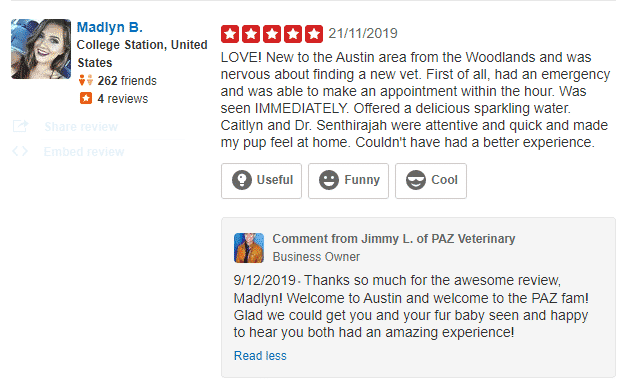
Be sure to obtain reviews from loyal clients while the experience is fresh in their minds. Review sites often become a complainer’s paradise as it seems that the only reviewers are the unhappy ones.
While you’re bound to get a few negative reviews, no matter how great your services are, make sure the positive ones greatly outweigh them by trying to engage those happy clients.
Again, just letting them know where reviews can be posted and politely asking them to do so will greatly increase your online reputation.
Online reviews are more than just a fad, they’re here to stay. Pet owners now rely on them as part of their decision process when it comes to who will care for a member of their family.
Increase your positive online reviews by continuing to provide a great service and asking satisfied clients to write about it. The better online reputation you can garner, the greater the number of new clients there will be bringing pets through your door.

Veterinary Digital Marketing Made Easier with Vetstoria
To promote or not to promote? The answer is usually yes, especially if your practice suffers from days of low footfall. Promotions or ‘campaigns’ can supplement the flow of pet-owners through your door when done right. There are, however, challenges in creating effective veterinary digital marketing campaigns.
Why control matters in the veterinary industry
One of the biggest challenges faced by practices that run promotional marketing campaigns online is a lack of control. In particular, the ability to control the dates, times, and the number of slots available for a specific promotion.
Let’s say you run a promotion for discounted vaccinations on Facebook. The response is great. You’re inundated with appointments. However, they all happen to be during your busiest times, or with your experienced vets who are already very busy while your new graduate who just joined has more availability. It could end up being counterproductive and create more headaches for your team.
In cases where a vet practice takes appointments over the phone or manually confirms requests, new problems arise. Promotional campaigns can create more manual work for an already busy front desk. And if a scheduling solution that integrates with your practice management system is not in place, the distribution of labor can become challenging. Finally, the campaigns are extremely difficult to track!
Tracking the performance of veterinary digital marketing campaigns
Tracking the performance of digital marketing campaigns is a challenge experienced across many industries. But it is even more apparent within the veterinary industry, as the primary call to action for many practices is a phone call or appointment request, which are both hard to track, since the conversion (appointment confirmation) takes place offline.
To run effective veterinary digital marketing campaigns, you need to track the performance of each campaign. This is made much easier by having a ‘trackable’ action, such as real-time appointment booking, on your website.
It also helps if you measure vital metrics, such as the number of clicks on your promotion, conversion rate (promotion clicks to appointments ratio), and revenue generated. There are additional metrics you can track, too, such as the devices used or time of day appointments are booked.
By tracking these metrics, you’ll be able to judge the performance of each promotional campaign and decide whether to invest more in the campaigns and channels that generate the best results for your next promotion.
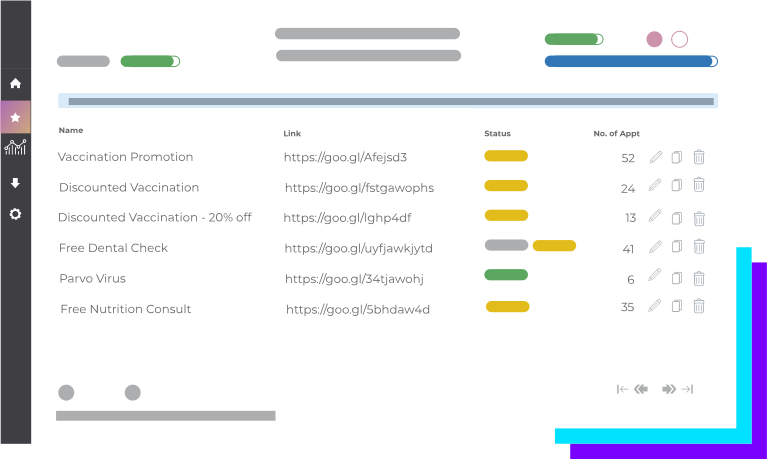
This is where Vetstoria’s Digital Marketing feature comes in. It allows veterinary practices to take control of their promotional campaigns and track results, leading to impactful promotions that deliver positive returns on investment.

Digital Marketing with Vetstoria
Vetstoria’s Digital Marketing feature offers an intuitive and powerful way to manage and track veterinary promotions. Here’s how it works:
1. Name your campaign - choose a unique name that will help you identify the promotion, for example, “Cat Appreciation Day - Free Cat Dental Check - Facebook - 20Jan2019”
2. Set custom rules that determine the specifics of your campaign. Some basic attributes include:
- The dates and duration of the campaign
- Maximum number of appointments you want to offer
- The species the campaign applies to
- The specific vets or technicians/nurses that serve the appointments
- Any time or date exclusions you wish to put in place
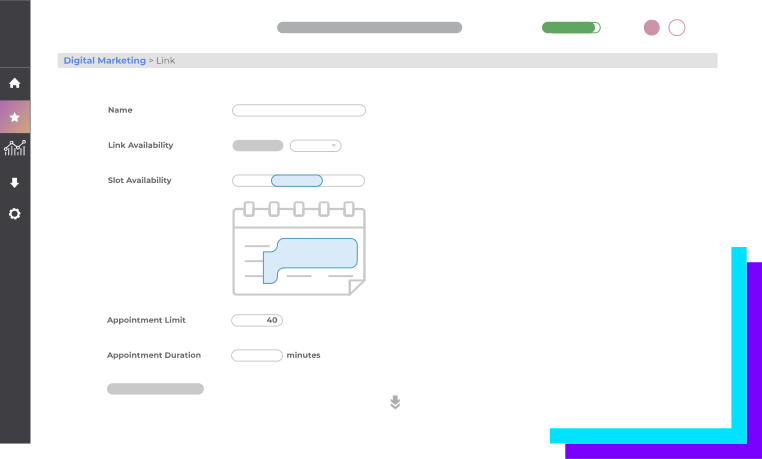
3. Vetstoria will then generate a Digital Marketing Link, a unique short link for the campaign that you can use across your marketing channels and third-party apps such as PetDesk, iRecall, or Vet2Pet, as well as a QR code that can be used on any printed materials.
4. Pet-owners who arrive on your scheduling page through these links will only see the modified appointments that have just been set up. This is important when trying to drive footfall during quiet periods, as only the selected times and dates will be shown as available.
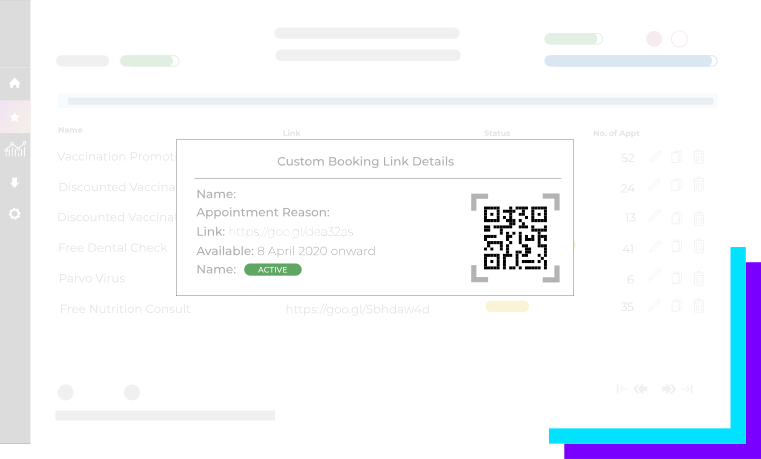
Using Digital Marketing Links
Once a Digital Marketing Link is created in Vetstoria, it’s ready to be used across various marketing channels, including Google and Facebook. Create a post or ad with content that is related to your promotion, include the unique link, and you’re set. When an appointment is scheduled using the link, you’ll know exactly which promotion it came from.
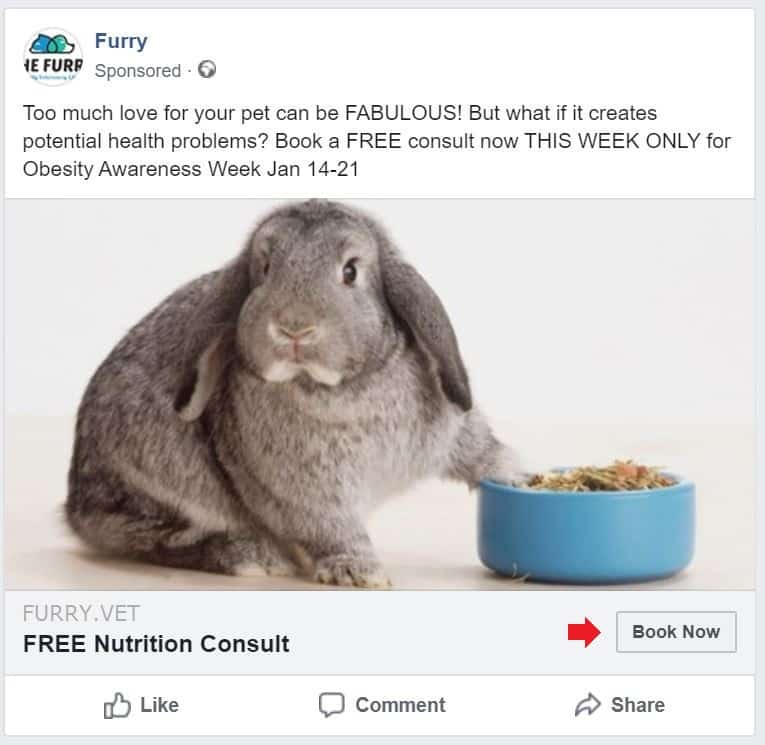
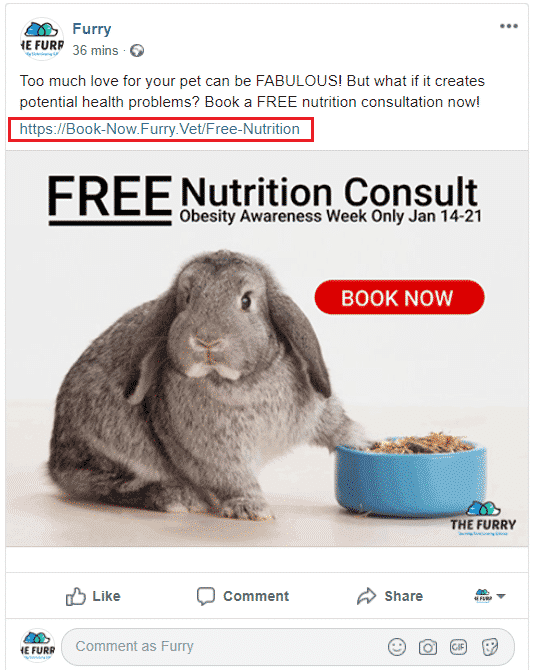
The benefit of running seemingly one-off campaigns stretches way beyond the promotional period. The campaigns usually sign-post the subsequent course of action like preventative care in a follow-up. For example, a free dental check campaign for rabbits can be set up for technicians, after which follow-up appointments can be scheduled should symptoms of early-stage dental disease be identified.
However, it shouldn’t stop here. It’s important to track, analyse and compare the performance of your campaigns. For the most effective marketing promotions, the process should be continuous, and Vetstoria provides you with the tools for it.
Analytics, reporting and Google Analytics integration
Within the Vetstoria Digital Marketing Dashboard, you are able to analyse each individual campaign’s performance and view key metrics such as promotion clicks, conversion rate (clicks to bookings ratio), and the number of clients acquired through your promotions.
For practices that have Google Analytics enabled on their websites, Vetstoria integrates seamlessly with the analytics tool to paint the full picture and provide insights to help you get the most return on investment for your promotional efforts. Compare campaigns and performance across your channels and decide where to invest future spending.
If you’re already a customer and want to learn more about our Digital Marketing feature contact our friendly support team.
If you are not yet using Vetstoria in your practice, why not book a 30-minute demo, so you can see how we’ve helped thousands of practices connect with their clients the modern way?
